Keary has been selected as a 2022 Kavli Fellow, as nominated by the National Academy of Sciences. AS part of this program, Keary will be part of the US delegation to the 19th Chinese-American Kavli Frontiers of Science Symposium in Irvine, CA, from July 8-10. Congrats, Keary!
The final version of our study on site-selective W(0)/W(II)-catalyzed alkene isomerization/carbonylation appears this week in Nature Chemistry. In this method, we take advantage of the ability of tungsten to undergo changes between six- and seven-coordinate geometries during the W(0)/W(II) redox couple. In conjunction with a conformationally flexible bidentate directing auxiliary, selective isomerization to (and subsequent functionalization at) classically disfavored positions can be achieved. Congrats to project lead Tanner and visiting undergrad Ziyang (Nick); our collaborators at the University of Pittsburgh, Will, Yu, and Peng; our resident analytical wizard Jason from the Scripps ASF, and crystallographer extraordinaire Milan from UCSD.
The final version of our collaborative study with the Grotjahn lab at SDSU and the Bertrand lab at UCSD has been accepted for publication in ACS Catalysis and appears online this week. We find that under (CAAC)Cu catalysis (CAAC = cyclic (alkyl)(amino)carbene), three-component carboboration of terminal alkynes takes place to furnish branched alkenyl boron compounds with high levels of regioselectivity. Building on our prior findings, we show the CAAC ligands can override substrate control factors and dictate regioselectivity of borylcupration with various carbon electrophiles, including alkyl iodides and allyl alcohol derivatives. Congrats to the entire project team: Yang, Nana, Skyler, Mingyu, and Aaron from our lab; Sima and Doug from SDSU, and Rudy and Guy from UCSD.
Congrats to Luke Oxtoby, who successfully defended his thesis this week, becoming the eighth Ph.D. graduate from the Engle lab. Luke’s research addressed an important problem by establishing the use of (co-catalytic) transient directing groups in palladium-catalyzed alkene functionalization. Next month, Luke will begin a position as a process chemist at Sterling Pharma Solutions in Germantown, Wisconsin. Congratulations Dr. Oxtoby!
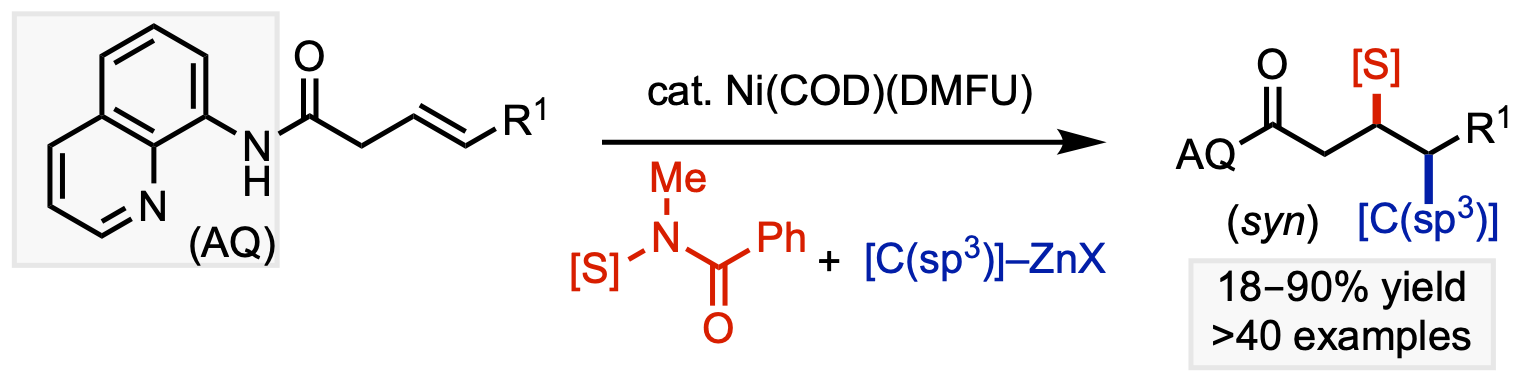
The final version of our paper describing the directed, nickel-catalyzed syn-1,2-alkylsulfenylation of unactivated alkenes has been accepted for publication in Chemical Science and appears online this week. Building upon our earlier study on carbosulfenylation, this method accommodates C(sp3) nucleophiles for the first time, allowing for simultaneous C(sp3)–S and C(sp3)–C(sp3) bond formation . Congrats to graduate students Zi-Qi and Hui-Qi, as well as our undergraduate intern Wen-Ji.
In the latest story arising from our lab’s Bristol Myers Squibb collaboration, we report the design of a sterically tuned directing auxiliary, picolinyl-α,α-gem-diethyl amine (PDE), which promotes C(sp3)–F reductive elimination from a Pd(IV) intermediate and enables efficient syn-1,2-carbofluorination of unactivated alkenes under Pd(II)/Pd(IV) catalysis. The improved yield of PDE versus classical directing auxiliaries, such as 8-aminoquinoline (AQ) and 2-(pyridin-2-yl)isopropyl (PIP) is rationalized by comparison of % buried volume (%VBur) across the three pre-reductive-elimination intermediates. Great work by Zhonglin, Luke, Zi-Qi, and Nana on the Scripps side and Geraint from BMS Discovery Chemistry.
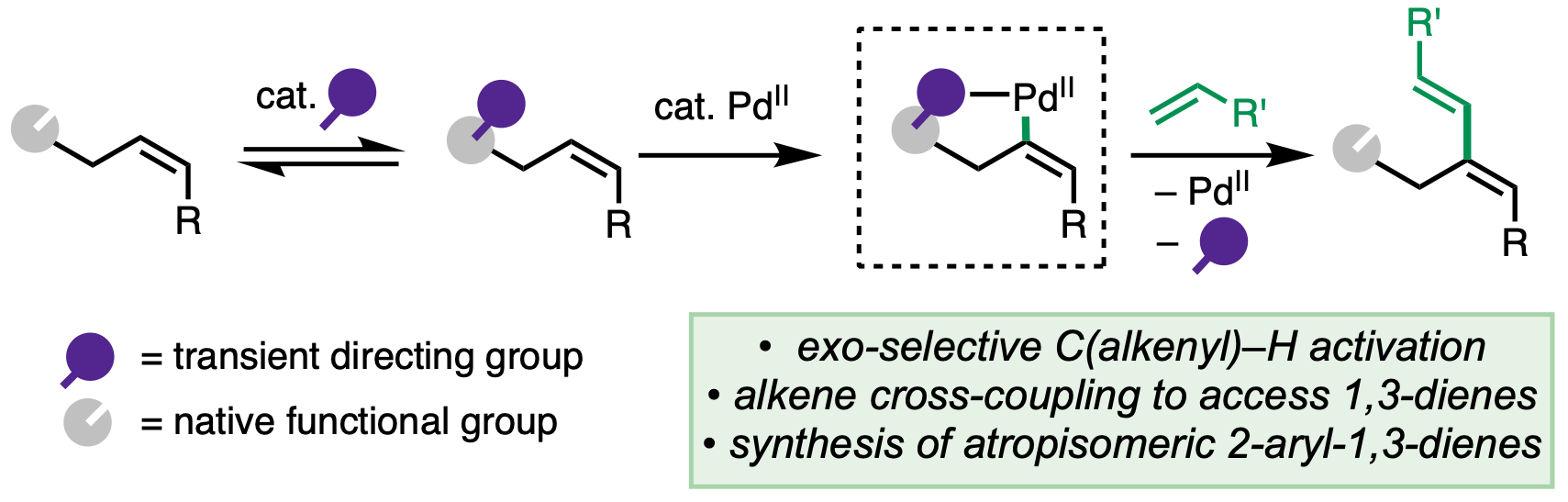
The final version of our collaborative study with the laboratory of Prof. Peng Liu on site-selective palladium(II)-catalyzed C(alkenyl)–H activation enabled by a transient directing group (TDG) appears online today in Angewandte Chemie International Edition. This project continues our research program in developing alkene functionalization reactions that take advantage of reversible attachment of a catalytic mediator (i.e., a TDG). In this work, we show that the presence of a tailored carboxylic acid co-catalyst in conjunction with an amino acid TDG enables C(alkenyl)–H activtion via an exo-palladacycle intermediate. We develop an atropselective method that enables access to axially chiral substituted 1,3-dienes, synthesize alkenyl palladacycle model complexes, and examine the reaction mechanism through DFT. Congrats to Mingyu, Juntao, Tugce, Hui-Qi, and Raul for a great paper!
Congrats to Dr. Skyler Mendoza who has received a National Science Foundation Mathematical and Physical Sciences Ascending Postdoctoral Research Fellowship (NSF MPS-Ascend) to support his work developing dual catalytic fragment insertion methods as well as various outreach activities in San Diego County. Prior to joining the Engle lab in November 2021, Skyler received his Ph.D. from Caltech, where his research in the lab of Prof. Sarah Reisman focused on natural products total synthesis and synthetic methods development. Congrats Skyler!
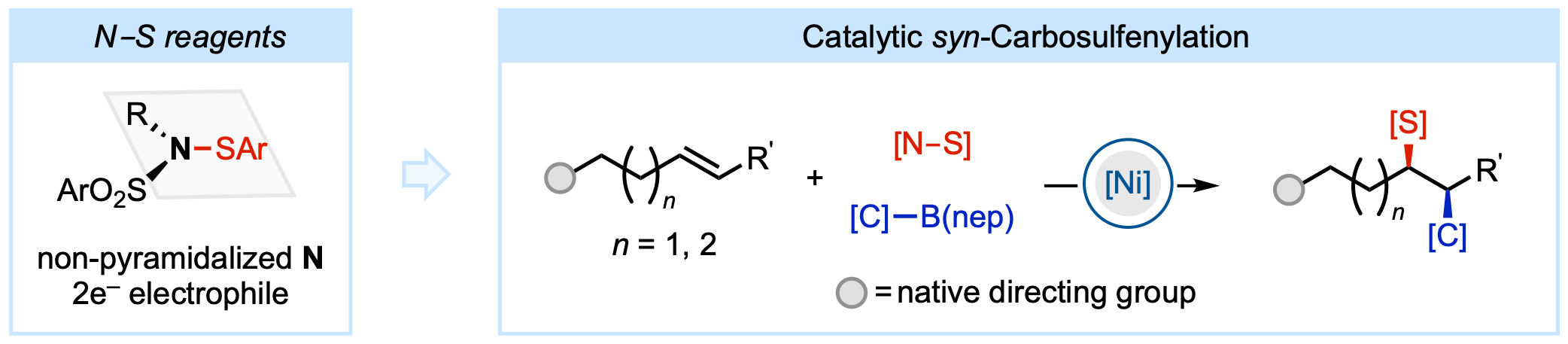
The final version of our paper describing Ni(I)/Ni(III)-catalyzed carbosulfenylation is online today in the Journal of the American Chemical Society. The method allows conversion of a diverse collection of widely available alkenes bearing native directing groups to structurally complex organosulfide products, with reactivity and selectivity emanating from specially tailored N–S electrophiles. The syn-stereoselectivity of the reaction complements classical thiiranium chemistry, which delivers anti-sulfenylfunctionalized products. Congrats to graduate students Zi-Qi and Taeho and former SURF intern Yilin. Great work!
Congrats to G4 student Zi-Qi Li, who has been selected to participate in the inaugural Corteva Agriscience Chemistry Scholars Symposium to be held at Corteva’s Global Headquarters in Indianapolis, IN on May 11-13th, 2022! During the symposium, Zi-Qi and other awardees will present their research, tour Corteva’s facilities, and learn about industrial R&D in the agricultural chemistry industry.









 Molecular Complexity through Catalysis