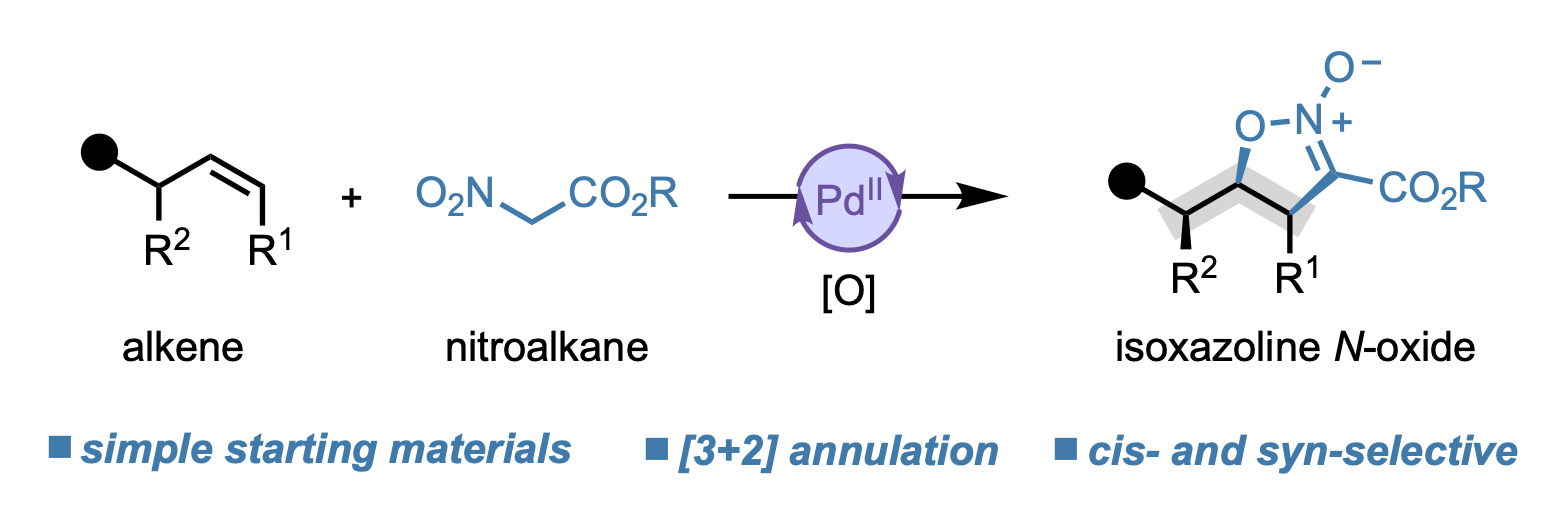
In our earlier work on Pd(II)-catalyzed cyclopropanation of alkenyl amides with nitroalkanes, we noticed an intriguing byproduct that had gone unaccounted for. When we revisited the reaction and subjected this material to X-ray crystallography, it turned out to be an isoxazoline N-oxide—a member of a versatile yet underexplored class of heterocycles. Recognizing the opportunity, we set out to develop conditions that would favor formation of this product selectively. We are pleased to share the results of those efforts in Organic Letters!
By switching precatalyst, base, and solvent, Yiyao, Hui-Qi, Lan, Yilin, and Shenghua were able to redirect the reaction pathway and access intricately functionalized isoxazoline N-oxides in a single step from simple alkenyl amides and nitroalkanes via Pd(II)/Pd(IV) catalysis. The method delivers products with high diastereoselectivity and the N-oxide scaffolds proved to be versatile intermediates — amenable to reduction, auxiliary removal, and 1,3-dipolar cycloaddition for downstream access to diverse nitrogen-containing frameworks. Congratulations to all co-authors and our collaborators Nick Scherschel and Prof. Davin Piercey at the Purdue Energetics Research Center!
Read the paper in Organic Letters: https://pubs.acs.org/doi/10.1021/acs.orglett.6c01696