Catalytic Asymmetric alpha-Alkylation of Azlactones with Alkenes – Now In Press

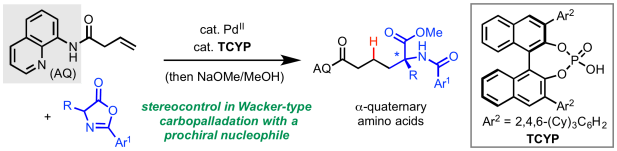
For the past two years the Engle lab has been hard at work developing effective strategies to control enantioselectivity in catalytic directed alkene hydrofunctionalization and 1,2-difunctionalization. Today, a new method for enantioselective α-alkylation of azlactones with non-conjugated alkenes via Pd(II)/chiral phosphoric acid catalysis was accepted for publication in Angew. Chem. Int. Ed. (click here). This unique transformation enables preparation of highly functionalized quaternary α-amino acids. In collaboration with Prof. Peng Liu, we performed a series of detailed experimental and computational studies to elucidate a viable model to explain stereoinduction in which the CPA plays the dual role of coordinating to the incoming carbon nucleophile during reversible carbopalladation and then serving as a proton transfer mediator in the turnover-limiting protodepalladation step. Congrats to all of the authors from the Engle lab—Sri, Mingyu, Malkanthi, De-Wei, and Omar! Thanks too to Prof. Liu and Dr. Jason Chen from the Automated Synthesis facility at Scripps Research. In case anyone missed it, a pre-print of this work was published on ChemRxiv back in early November (click here).
enantioselective

Van wins 2019 WCC/Merck Research Award

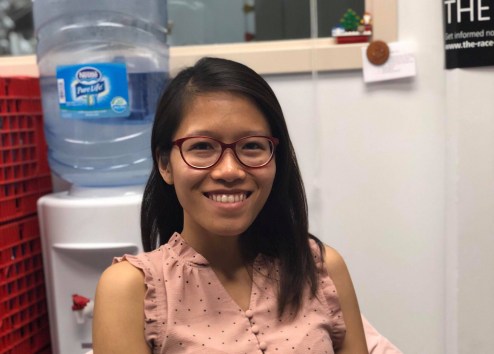
Congrats to superstar G3 student and Van Tran on being selected for the 2019 WCC/Merck Research Award. The WCC/Merck award recognizes 8 outstanding female scientists across the country and provides them with the opportunity to present their research along with fellow awardees at a special session at the Fall ACS Meeting in San Diego. In the Engle lab, Van’s research has focused on nickel-catalyzed conjunctive cross coupling (J. Am. Chem. Soc. 2017, 139, 10657) and on palladium-catalyzed strong-bond activation via β-X elimination (Nat. Chem. 2018, 10, 1126). Outside of the lab, Van serves as Advocacy Co-Chair for the Scripps Network for Women in Science (NWiS). Thanks to Merck for the their support, and way to go Van!

IMG_6329

Xiaohan finishes her internship

Xiaohan finishes her six-month internship this week, just in time to return home to spend Chinese New Year with her family. Xiaohan gave an awesome wrap-up talk describing her work on enantioselective directed carboboration of alkenes, and then the lab sent her off in style with a celebratory Korean BBQ lunch. Xiaohan will receive her Bachelor’s degree in chemistry this spring from Nankai University, and she will then return to the US next fall to begin her PhD (exact location still TBD). Thanks for all of your contributions to the lab, Xiaohan! We will miss you!

Enantioselective and Stereoconvergent anti-carboboration of alkenyl carbonyl compounds

Today we report our first foray into the enantioselective 1,2-difunctionalization of alkenes, with a new method for palladium(II)-catalyzed asymmetric anti-carboboration. The reaction is promoted by a palladium(II) catalyst and a mono-dentate oxazoline (MOX) ligand. This reaction was found to be stereoconvergent, with both E- and Z-configured alkenes giving the same major diastereomer. Mechanistic studies were performed to shed light on the origin of this phenomenon. A pre-print of this work is available on ChemRxiv (click here). Congrats to the authors, Zhen, Xiaohan, and May, particularly our two undergraduate co-authors Xiaohan and May.

carboboration2

December Outreach Events

It’s the season of giving and what better way to celebrate the holidays than with non stop outreach opportunities! First, we had the boss young scientists of BEWiSE hosted by Fleet Science come learn about organometallics. Then students from the distant lands of Palm Springs came to help us set things on fire. (This time no evacuation!)

Practical 1,2-Diarylation of Alkenes Directed by Simple Amides – Now In Press

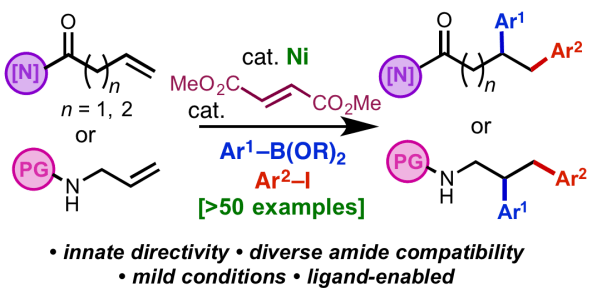
The nickel team strikes again, with a final version of our nickel-catalyzed alkene 1,2-diarylation paper appearing online in final form at J. Am. Chem. Soc. (click here). Through identification of an effective electron-deficient olefin ligand, this catalytic system allow for use of simple commonly encountered primary, secondary, and tertiary amides as directing groups, including those that are native to various target compounds of interest. Additionally, this work represents one of the rare cases in 1,2-diarylation chemistry where an aryl boronic acid derivative can be used as the nucleophilic coupling partner. Congratulations to Joe, Roman, Van, and Malkanthi from the Engle lab and Steve and Martin from Bristol-Myers Squibb. Thanks to everyone involved for a great collaboration. In case anyone missed it, a pre-print of this work was published on ChemRxiv back in early November (click here).

toc

2018 Engle Lab Holiday Party

The Engle lab celebrated it’s 4th annual holiday party in style, with a great potluck, a lively white elephant gift exchange, and a fierce Mario Tennis/MarioKart competition on Keary’s new Nintendo Switch. Happy holidays from our lab family to yours! Here’s to a great 2018!


Three-Component Umpolung Carboamination – Now in Press

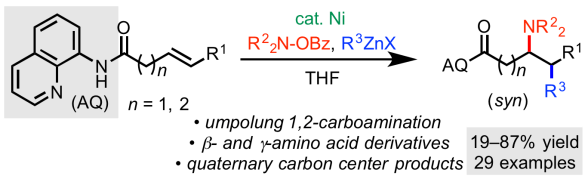
Vincent and Joe’s paper on three-component, nickel-catalyzed umpolung carboamination of alkenyl carbonyl compounds appears online today in final form at ACS Catalysis (click here). This unique transformation enables syn-selective delivery of nitrogen and carbon substituents of choice across an alkene and allows for formation of exceptionally hindered C(sp3)–C and C(sp3)–N bonds. It represents one of the few rare examples in which amine-directed N–O electrophiles (first used in two-component cross-couplings by Johnson) have been integrated into a nickel-mediated alkene functionalization process. It’s a special treat to highlight that the project lead, Vincent (now a grad student upstairs with Ryan Shenvi), performed this work as his senior-year undergrad research project while at UCSD. Props to Joe for great mentorship, and congrats to both authors! In case anyone missed it, a pre-print of this work was published on ChemRxiv back in early November (click here).

carboamination

IMG_5835

New High School Intern Joins the Lab

Our newest high school intern Matt joins us from San Diego High School and will be working with A.M.R (G3). Matt has found his new favorite piece of glassware, the rotavap cow, and can rotavap down 4 reactions at once. Welcome Matt!