Enantioselective and Stereoconvergent anti-carboboration of alkenyl carbonyl compounds

Today we report our first foray into the enantioselective 1,2-difunctionalization of alkenes, with a new method for palladium(II)-catalyzed asymmetric anti-carboboration. The reaction is promoted by a palladium(II) catalyst and a mono-dentate oxazoline (MOX) ligand. This reaction was found to be stereoconvergent, with both E- and Z-configured alkenes giving the same major diastereomer. Mechanistic studies were performed to shed light on the origin of this phenomenon. A pre-print of this work is available on ChemRxiv (click here). Congrats to the authors, Zhen, Xiaohan, and May, particularly our two undergraduate co-authors Xiaohan and May.

carboboration2

December Outreach Events

It’s the season of giving and what better way to celebrate the holidays than with non stop outreach opportunities! First, we had the boss young scientists of BEWiSE hosted by Fleet Science come learn about organometallics. Then students from the distant lands of Palm Springs came to help us set things on fire. (This time no evacuation!)

Practical 1,2-Diarylation of Alkenes Directed by Simple Amides – Now In Press

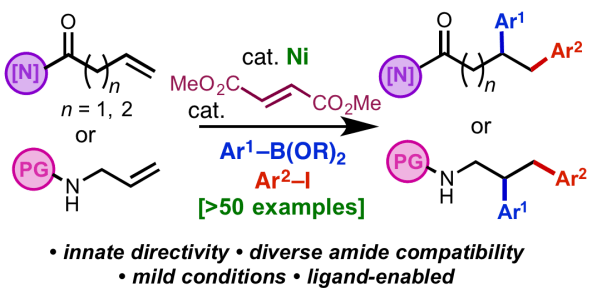
The nickel team strikes again, with a final version of our nickel-catalyzed alkene 1,2-diarylation paper appearing online in final form at J. Am. Chem. Soc. (click here). Through identification of an effective electron-deficient olefin ligand, this catalytic system allow for use of simple commonly encountered primary, secondary, and tertiary amides as directing groups, including those that are native to various target compounds of interest. Additionally, this work represents one of the rare cases in 1,2-diarylation chemistry where an aryl boronic acid derivative can be used as the nucleophilic coupling partner. Congratulations to Joe, Roman, Van, and Malkanthi from the Engle lab and Steve and Martin from Bristol-Myers Squibb. Thanks to everyone involved for a great collaboration. In case anyone missed it, a pre-print of this work was published on ChemRxiv back in early November (click here).

toc

2018 Engle Lab Holiday Party

The Engle lab celebrated it’s 4th annual holiday party in style, with a great potluck, a lively white elephant gift exchange, and a fierce Mario Tennis/MarioKart competition on Keary’s new Nintendo Switch. Happy holidays from our lab family to yours! Here’s to a great 2018!


Three-Component Umpolung Carboamination – Now in Press

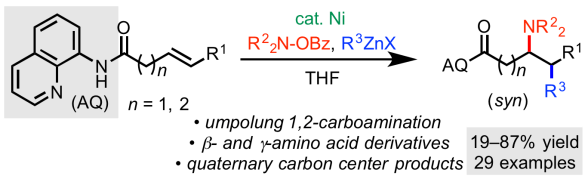
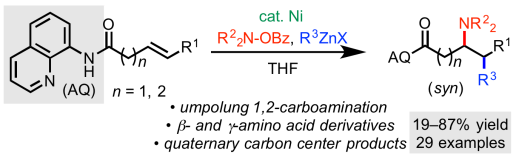
Vincent and Joe’s paper on three-component, nickel-catalyzed umpolung carboamination of alkenyl carbonyl compounds appears online today in final form at ACS Catalysis (click here). This unique transformation enables syn-selective delivery of nitrogen and carbon substituents of choice across an alkene and allows for formation of exceptionally hindered C(sp3)–C and C(sp3)–N bonds. It represents one of the few rare examples in which amine-directed N–O electrophiles (first used in two-component cross-couplings by Johnson) have been integrated into a nickel-mediated alkene functionalization process. It’s a special treat to highlight that the project lead, Vincent (now a grad student upstairs with Ryan Shenvi), performed this work as his senior-year undergrad research project while at UCSD. Props to Joe for great mentorship, and congrats to both authors! In case anyone missed it, a pre-print of this work was published on ChemRxiv back in early November (click here).

carboamination

IMG_5835

New High School Intern Joins the Lab

Our newest high school intern Matt joins us from San Diego High School and will be working with A.M.R (G3). Matt has found his new favorite piece of glassware, the rotavap cow, and can rotavap down 4 reactions at once. Welcome Matt!

Enantioselective alkylation of prochiral nucleophiles via a carbo-Wacker pathway

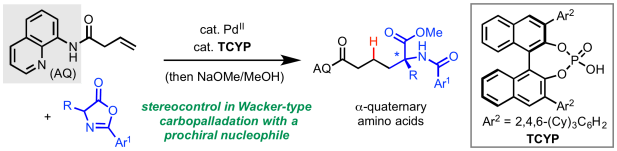
The third and final birthday preprint is now online in ChemRxiv. In this manuscript we report a previously unexplored mode of stereoinduction in Wacker type nucleopalladation—namely, desymmetrization of prochiral carbon-nucleophiles. The new method employs the dual action of palladium(II) to activate the alkene and a chiral phosphoric acid (CPA) to provide stereoinduction in the enantioselectivity-determining protodepalladation step. Congrats to the authors, Sri, Mingyu, Malkanthi, De-Wei, and Omar, as well as collaborators Jason Chen from the Automated Synthesis Facility at Scripps Research and Peng Liu from University of Pittsburg. Nice work! For a link to the manuscript, click here.

enantioselective

Ligand-Accelerated 1,2-Diarylation of Alkenes Directed by Simple Amides.

The second installment of the birthday preprint trilogy appears online today in ChemRxiv. This exciting contribution represents the culmination of a long and arduous research journey. By way of background, much of our lab’s work in alkene functionalization has strategically employed removable bi- and tridentate directing auxiliaries to control regioselectivity and stabilize key alkylmetal intermediates in catalysis. Achieving analogous reactivity with simple, monodentate functional groups has proven to be a significant challenge. In this manuscript, we report that electron-deficient olefin (EDO) ligands dramatically promote reactivity in directed 1,2-diarylation of simple alkenyl amides, offering a strong platform for future development of challenging alkene functionalization reactions of ubiquitous alkene starting materials. Congrats to the authors, Joe, Roman, Van, and Malkanthi, as well as our spectacular collaborators from BMS, Steve and Martin. Great work, team! For a link to the manuscript, click here.

edo

Umpolung Carboamination Preprint Online

The first of three birthday preprints is now online at ChemRxiv. The manuscript describes our adventures in using N–O electrophiles in nickel-catalyzed alkene functionalization, namely directed 1,2-carboamination of alkenyl carbonyl compounds. This work represents the first example of a three-component nickel-catalyzed reaction employing an N–O reagent. In terms of preparative utility, the transformation enables controlled formation of highly hindered C–N bonds, offering a potentially powerful platform for applications in medicinal chemistry. Congrats to the authors, Vincent (who performed the lion’s share of the work as his undergraduate project) and Joe (who was a great mentor throughout the process). Well done! For a link to the manuscript, click here.

carboamination