Ketone-Directed Nickel-Catalyzed 1,2-Diarylation of Alkenes: Pre-Print Now Online

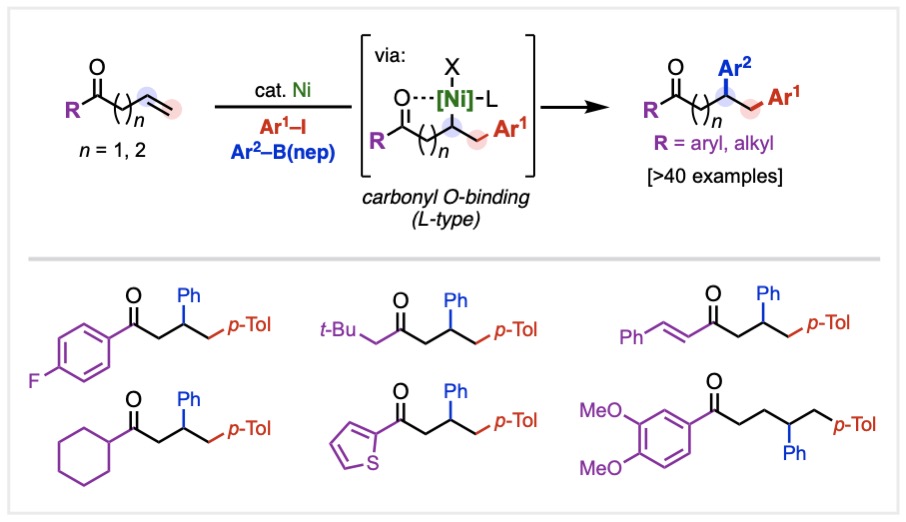
The latest work from Team Nickel and the Bristol Myers Squibb collaboration is now online as a pre-print in ChemRxiv. The paper describes extension of carbonyl-directed nickel-catalyzed alkene 1,2-diarylation to alkenyl ketone substrates, which are challenging owing to the weaker Lewis basicity of the ketone lone pair as well as the increased susceptibility to unwanted isomerization. We also conducted a comparative study of the different reaction conditions that have been published for this family of transformations in order to identify key similarities and differences. Hats off the fantastic team led by visiting student Roman (now a Ph.D. student with Frank Glorius at WWU Münster) and second-year grad student Omar. Also contributing were Joe, Malkanthi, Zi-Qi, and Van, as well as Steve from BMS Process. Awesome stuff, team!

For a link to the pre-print, click here: https://chemrxiv.org/articles/preprint/Nickel-Catalyzed_1_2-Diarylation_of_Alkenyl_Ketones_A_Comparative_Study_of_Carbonyl-Directed_Reaction_Systems/14150174

Another Virtual Outreach Event!

We did something a little different from chemistry… With the help of the talented middle schoolers at Barrio Logan College Institute, we built ROBOTS! It was so fun to work with these students and ensure all have access to science, even in a pandemic. We provided curated science kits to each student and led small groups over zoom. Thanks BLCI for spending your workshop night with us!

Yang completes his postdoc and departs for Corteva

After three hugely successful years in the Engle lab, Dr. Yang Gao departs this week to begin a position in Discovery Chemistry at Corteva in Indianapolis, IN. In the Engle lab, Yang led our research program in copper catalysis and collaborated with both the Liu lab at the University of Pittsburgh and the Bertrand lab at UCSD. His love for copper chemistry runs so deep that it was only fitting that he and his wife named their new German shepherd puppy “Copper.” In addition to educating everyone in the lab about mechanistic organometallic chemistry, Yang managed to also teach the Scripps community some new moves on the hardwood as well. Best of luck on your new adventure, Yang!

2021 Grad Recruitment Weekends are Here

Welcome to all prospective graduate students who are visiting us virtually this week and two weeks from now. Everyone at Scripps Research wishes that we could be with you in person to share our exciting science (and temperate weather) with you. To give everyone a flavor for life in the Engle lab, we put together a virtual tour. Props to Camille, Nana, and all of the featured lab members!

Keeping with lab tradition during recruitment season, Hermione features prominently!

Latest Pre-print Unveils An Unexpected Organometallic Rearrangement

Today in ChemRxiv we report an unusual and surprising organometallic rearrangement triggered by addition of Pd(TFA)2 to at alkenyl benzothiazole thioether (BT(S)). This story started two years ago. While wrapping up an in-depth study of the BT(S) directing group and its various uses in palladium(II) catalysis (ACS Catal. 2019, 9, 7626), Andrew treated a standard substrate with Pd(TFA)2. Rather than forming the PdX2(substrate)2 complex like we was with other Pd(II) salts, Andrew obtained an unusual structure where the organic ligand had undergone significant rearrangement and was now coordinated as a bidentate N,S-heterocyclic-carbene–tetrahydrothiophene—shout out to UCSD Crystallography for elucidating the structure! Andrew then teamed up with a high school intern, Matt Demer (now at UC Davis), and continued close collaboration with crystallographers Milan and Arnie from UCSD to understand the scope, limitations, and mechanism of this process. Bravo, Andrew and team!

For a link to the pre-print, click here: https://chemrxiv.org/articles/preprint/Ligand_Rearrangement_Leads_to_Tetrahydrothiophene-Functionalized_N_S-Heterocyclic_Carbene_Palladium_II_Complexes/13633301

Enantioselective 1,2-Arylfluorination via A Transient Directing Group Strategy – Pre-Print Online

Since our lab’s first paper establishing a transient directing group strategy for asymmetric Heck-type hydroarylation went online in 2019, we’ve been hard at work trying to extend this approach to three-component 1,2-difunctionalization. At long last we’ve succeeded, and we are thrilled to report the fruits of our labor: a remarkably versatile 1,2-arylfluorination reaction that can form fully substituted C(sp3)–Ar and C(sp3)–F stereo centers in up to >99% ee. Pivotal to the success of the project was use of design of experiments (DoE) to facilitate rapid optimization of reaction conditions and reaction progress kinetic analysis (RPKA) to elucidate the reaction mechanism. Hats off to Zhonglin, Luke, Mingyu, Zi-Qi, Van, and Yang on the landmark achievement!

For a link, click here: https://chemrxiv.org/articles/preprint/A_Transient_Directing_Group_Strategy_Enables_Enantioselective_Multicomponent_Organofluorine_Synthesis/13537283

Ni(COD)(DMFU) Precatalyst Paper Online

The holiday paper flurry continues! ❄️⛄️🥶 This time it’s Team Nickel, who together with collaborators at Bristol Myers Squibb describe the use of Ni(COD)(DMFU) as a well-defined, all-in-one precatalyst for alkene diarylation. This lovely red free-flowing solid can be conveniently prepared in high yield from Ni(COD)2 and is indefinitely thermally stable as long as handled in an inert-atmosphere glovebox. Congrats to the Scripps team, Nana, Van, and Omar, as well as BMS team, Steve and Martin. Here’s to another great year to come in the Scripps–BMS collaboration!

For a link to the paper, click here: https://www.thieme-connect.com/products/ejournals/abstract/10.1055/a-1344-6040

Alkoxide Decomposition Paper – In Press on Christmas Eve

‘Twas the night before Christmas 🎄 and… The final version of our paper with Bristol Myers Squibb (BMS) describing the facile decomposition of commonly used sodium alkoxide bases under air is now in press in ACS Catalysis. These bases maintain their appearance as free-flowing white or off-white solids while undergoing a complex decomposition process to various inorganic salts that is triggered by initial reaction with CO2 in the air. Congrats to the team: Bob, Aunji, Ryan, and Steve from BMS; and Joe, Van, Taeho, Omar, and Roman from Scripps!

Click here for a link to the paper: https://pubs.acs.org/doi/10.1021/acscatal.0c04124

The work first appeared as pre-print back in June: https://chemrxiv.org/articles/preprint/An_Under-Appreciated_Source_of_Reproducibility_Issues_in_Cross-Coupling_Solid-State_Decomposition_of_Primary_Sodium_Alkoxides_in_Air/12818234

Just in time for the holidays – Our [3+2] (Hetero)annulation paper is in press

Santa’s first delivery of the season has arrived 🎅 🎄 🎁 , with official acceptance and publication of our paper on [3+2] alkene (hetero)annulation in Nat. Commun. The project was carried out in collaboration with the Liu group at the University of Pittsburgh and the chemists from the Oncology Medicinal Chemistry Department at Pfizer, Inc. By taking advantage of a unique Pd(II)/Pd(IV) pathway that begins with directed nucleopalladation, this transformation conveniently furnishes indolines, dihydrobenzofurans, and indanes with trans stereochemistry across the ring juncture. The practicality of the method stems from its use of readily available alkenyl amide substrates and ambiphilic aryl halide coupling partners. Bravo to Hui-Qi, Pranali, Andrew, and Hou-Xiang from our lab, Ilia from the Liu lab, and Joyann, Shouliang, Michelle, and Indra from Pfizer.

Click here for a link to the paper: https://www.nature.com/articles/s41467-020-20182-4

The work first appeared as pre-print back in June: https://chemrxiv.org/articles/preprint/Anti-Selective_3_2_Hetero_annulation_of_Non-Conjugated_Alkenes_via_Directed_Nucleopalladation/12510038

2020 Engle Lab Holiday Party

The Engle lab continued its long-standing tradition of closing out the year with festivities—this time in Zoom format. We kicked things off with a Secret Santa gift exchange, complete with a full slate of predictions/guesses of who had whom, which were quickly debunked! Hermione enjoyed her gifts from Phillippa so much, she couldn’t resist showing off her new bow. We finished the night with several rounds of “Among Us”, rekindling our shared love of all Werewolf/Mafia-inspired games. Despite the challenges 2020 has thrown our way, we’ve gotten through it together, and we are looking forward to a safer and less Zoom-ful 2021!