Tungsten-Catalyzed Alkene Isomerization–Hydroboration – Now In Press

Appearing online today in J. Am. Chem. Soc., we are excited to share the final version of our paper on tungsten-catalyzed alkene isomerization–hydroboration, which we carried out in collaboration with the lab of Prof. Ruben Martin at ICIQ. This project represents an important step forward for our research program in low-valent tungsten-catalyzed alkene functionalization, a largely unexplored family of reactions. In this report, Tanner and Raul teamed up to demonstrate that simple amides are competent directing groups to mediate controlled isomerization and hydroboration of alkenes, allowing functionalization positions that are classical inaccessible via chain-walking methods. The method also represents the first tungsten-catalyzed hydroboration, and the mild nature of the process is exemplified by it’s tolerance for a number of sensitive functional groups (e.g., aryl halides) and epimerizable α-stereocenters. Congrats to Tanner, Raul, and Phillippa, and thanks to the Martin lab for the fun opportunity to join forces!
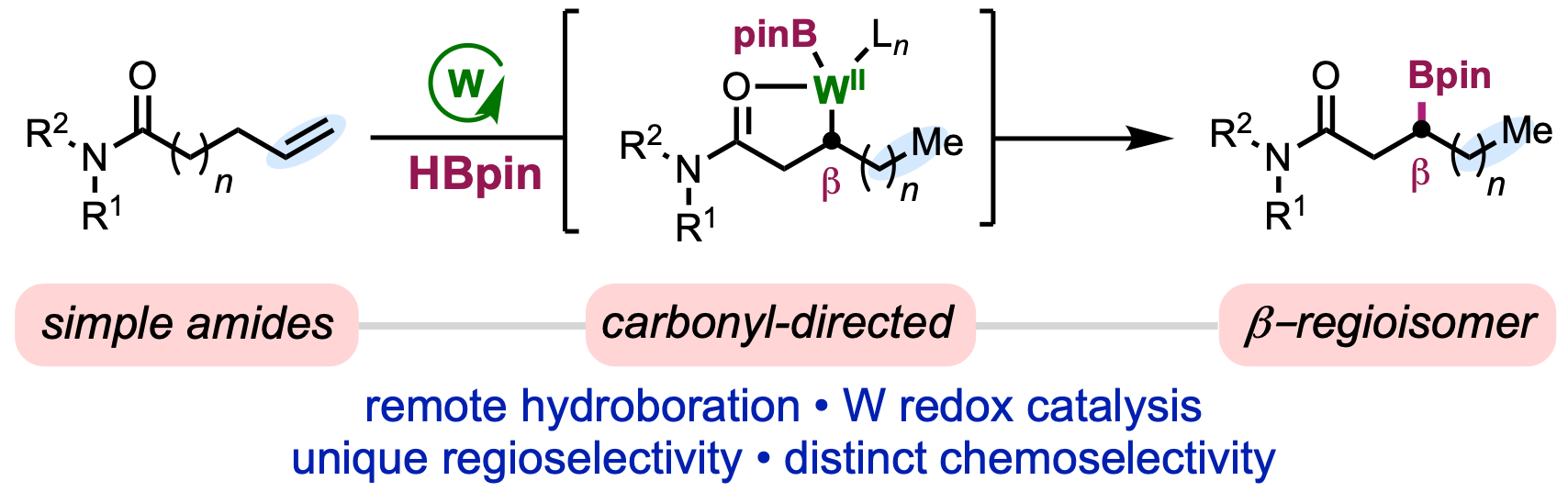
For a link to the paper in J. Am. Chem. Soc., click here: https://pubs.acs.org/doi/abs/10.1021/jacs.1c07162

As a reminder, a pre-print of the paper first appeared in ChemRxiv back in July: https://chemrxiv.org/engage/chemrxiv/article-details/60e77eb2551cb06ecbadb7a4

YILLIN AND JOSÉ COMPLETE SUMMER INTERNSHIPS

We bid Yillin and José farewell! After spending a chemistry-intense summer in Engle lab, Yillin heads back to Santa Babara, and José hops on a long flight back to Spain. It was a great joy to hear about their amazing accomplishments Ni-catalysis, in collaboration with Ziqi and Taeho, during their wrap-up talks. Everyone from the Engle lab is wishing them the best luck in their future endeavors.

Luke Selected for 2021 Abbvie Scholars Symposium

Congratulations to rising G4 student Luke Oxtoby who was chosen to represent Scripps Research and the Engle Lab at the 2021 AbbVie Scholars Symposium! The event takes place this week (Thursday, August 26) in virtual format, where Luke will have the opportunity to share his research with other students from around the country and with AbbVie scientists. Way to go, Luke!

Catalytic Carboamination of Free Alkenyl Alcohols – Paper Now In Press

For the past 5+ years, simple alkenyl alcohol substates have been on our wish list of “ideal” substrates for directed three-component alkene difunctionalization. However, extensive efforts within our lab and by others have proven that these starting materials are especially challenging due to a number of competitive side reactions that can arise (cyclization, alcohol oxidation, alkylmetal chain-walking, etc.). In an exciting study appearing online today in J. Am. Chem. Soc., Taeho and Nana together with Bristol Myers Squibb collaborators Peter, Klement, and Hao, have demonstrated a creative approach to integrate alkenyl alcohols into three-component carboamination that hinges on judicious tuning of the leaving group on the nitrogen electrophile. By carefully modulating the LUMO energy of this reaction partner, high pathway selectivity for the desired three-component coupling can be achieved across a broad array of substrates. Congrats to the team on this awesome advance!

For a link to the published manuscript in J. Am. Chem. Soc., click here: https://pubs.acs.org/doi/10.1021/jacs.1c07112.

As a reminder, a pre-print of this paper was published back in March: https://chemrxiv.org/engage/chemrxiv/article-details/60c7562e567dfebe64ec63f7

Engle Lab Receives 2021 NSF CAREER Award

The Engle Lab is thrilled to announce that we have received an NSF CAREER award to support ongoing research in the area of Pd(II)-catalyzed C(alkenyl)–H activation. This research project will allow us to determine the catalyst properties that drive selectivity for C(alkenyl)–H activation or nucleopalladation from common Pd(II)–π-alkene intermediates, towards our long term goal of developing a toolkit for universal alkene functionalization. The grant will also support ongoing outreach activities to communicate organometallic chemistry principles to diverse audiences and provide state-of-the-art training experiences to undergraduates and high school interns. We are grateful to the National Science Foundation for supporting this project, which will run for the next five years.

For more about the CAREER program, click here: https://www.nsf.gov/funding/pgm_summ.jsp?pims_id=503214

Welcome New Members!

To kick off the academic year, we welcome new members Dr. Amit Simlandy, Shenghua Yang, and Juntao Sun to the Engle lab!

Dr. Simlandy is here for his second postdoc; his first was with Prof. Kevin Brown at Indiana where he became the carboboration master. We are so happy to have him.

Shenghua is a Scripps veteran who did his undergraduate work in the Baran lab. We are glad we could convince him to move downstairs to join us.

After a tumultuous odyssey across land and sea, Juntao finally arrived in La Jolla to begin his PhD. His track record in the Engle lab shows that he will be publishing in no time.

Malkanthi receives 2021 Cottrell Postdoc Fellowship

Congrats to Dr. Malkanthi Karunananda, who was selected for a 2021 Cottrell Postdoctoral Fellowship from Research Corporation for Science Advancement with support from the National Science Foundation. The fellowship will support Malkanthi as she pursues computational studies of alkene functionalization reactions using a transient directing group strategy in collaboration with Prof. Ken Houk at UCLA. As part of the fellowship, Malkanthi will also co-teach a primer in computational chemistry for organic chemists. Congrats on this recognition, Malkanthi!

For more information about the program, click here: https://rescorp.org/cottrell-scholars/cottrell-fellowships

For a link to the award announcement, click here: https://rescorp.org/news/2021/09/rcsa-nsf-support-14-postdocs-in-2nd-year-of-cottrell-fellowships

Full Account of Ni-Catalyzed Markovnikov Hydroarylation – Now In Press

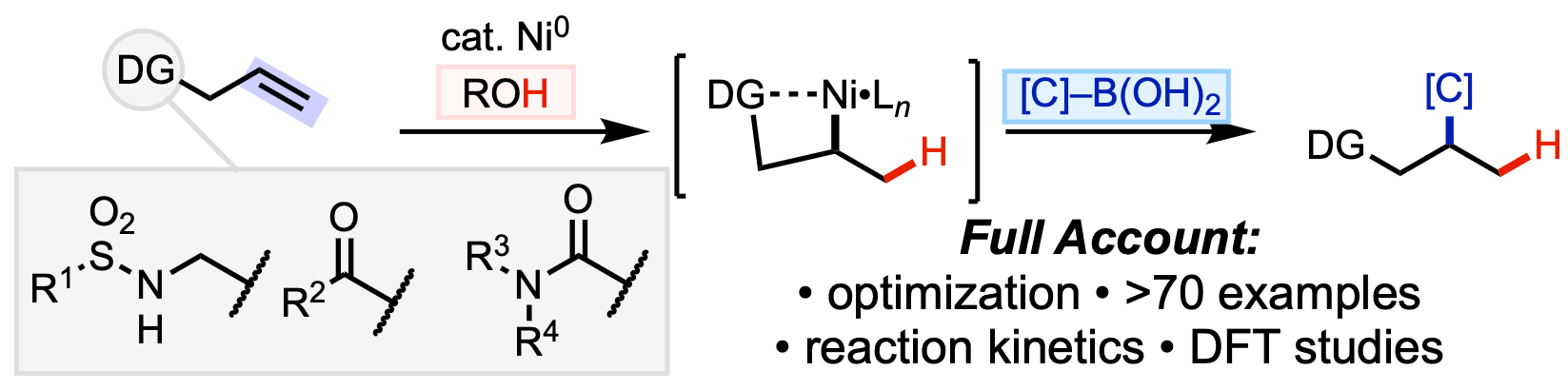
While alkene hydroarylation methods have advanced rapidly over the past few years, Markovnikov-selective methods remain rare. Last year, we reported Ni-catalyzed hydroarylation of alkenyl carboxylic acid substrates with arylboronic acids, where the Markovnikov or anti-Markovnikov product could be accessed by changing the ligand environment around the metal center. In an Edge Article appearing online today in Chemical Science, we report a full account of our efforts to expand the substrate scope and elucidate the mechanism of the Markovnikov-selective (“ligand-free”) version of this method. Effective reaction conditions for alkenyl sulfonamides, ketones, and amides were identified, and detailed mechanistic studies suggested that the turnover-limiting and regiodetermining step is arylboronic acid transmetalation. Bravo to Zi-Qi, Omar, and Ruohan on this tour de force.

Click here for a link to the article in Chemical Science: https://pubs.rsc.org/en/content/articlelanding/2021/sc/d1sc03121j#!divAbstract

As a reminder, a pre-print of this article appeared back in May: https://chemrxiv.org/engage/chemrxiv/article-details/60c7592dbb8c1a05f33dcb81

W-Catalyzed Isomerization–Hydroborylation Pre-Print Posted

Team Tungsten strikes again—with their latest pre-print appearing online today in ChemRxiv. This manuscript describes use of W(0) to catalyze site-selective isomerization–hydroboration of simple alkenyl amides. Conceptually, this work shows that native carbonyl groups can facilitate controlled alkene isomerization to otherwise disfavored positions, allowing for selective functionalization at classically inaccessible sites. Additionally, not only does this report mark the first use of W to catalyst a hydroboration reaction, it also demonstrates that W exhibits unique regioselectivity that complements that of existing methods with Rh and Ir. Congrats to the team, G4 student Tanner, visiting grad student Raul, and postdoc Phillippa. This study was performed in collaboration with Raul’s home lab, that of Prof. Rubén Martin at ICIQ in Tarragona, Spain.

For a link to the pre-print, click here: https://chemrxiv.org/engage/chemrxiv/article-details/60e77eb2551cb06ecbadb7a4