Palladium-catalyzed 1,2-carbofluorination paper – In Press at Angewandte Chemie

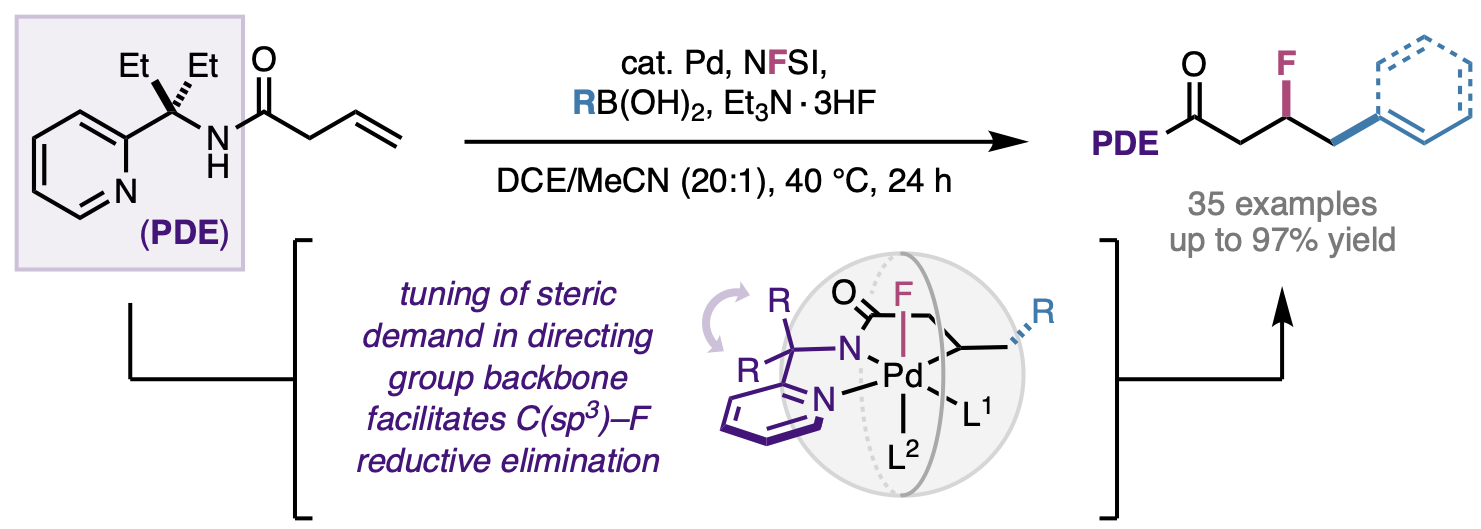
In the first of two papers appearing in final peer-reviewed form today, we report a new method for 1,2-carbofluorination of unactivated alkenes under Pd(II)/Pd(IV) catalysis in Angewandte Chemie International Edition. This new method is enabled by a unique sterically bulky gem-diethyl pyridyl amine directing group that coordinates to the palladium(II) catalyst in a bidentate fashion, controlling the regioselectivity of migratory insertion and promoting C(sp3)–F reductive elimination. The method can tolerate different substitution patterns of the alkene as well as a broad scope of aryl- and alkenylboron coupling partners. Congrats to entire team: Zhonglin, Luke, Juntao, Zi-Qi, and Nana from Scripps; and Geraint from BMS Discovery Chemistry.
For a link to the paper in Angewandte Chemie International Edition, click here: https://onlinelibrary.wiley.com/doi/10.1002/anie.202214153

As a reminder, this work was first described in a ChemRxiv pre-print back in April: https://chemrxiv.org/engage/chemrxiv/article-details/62608592d048ed03304b657d
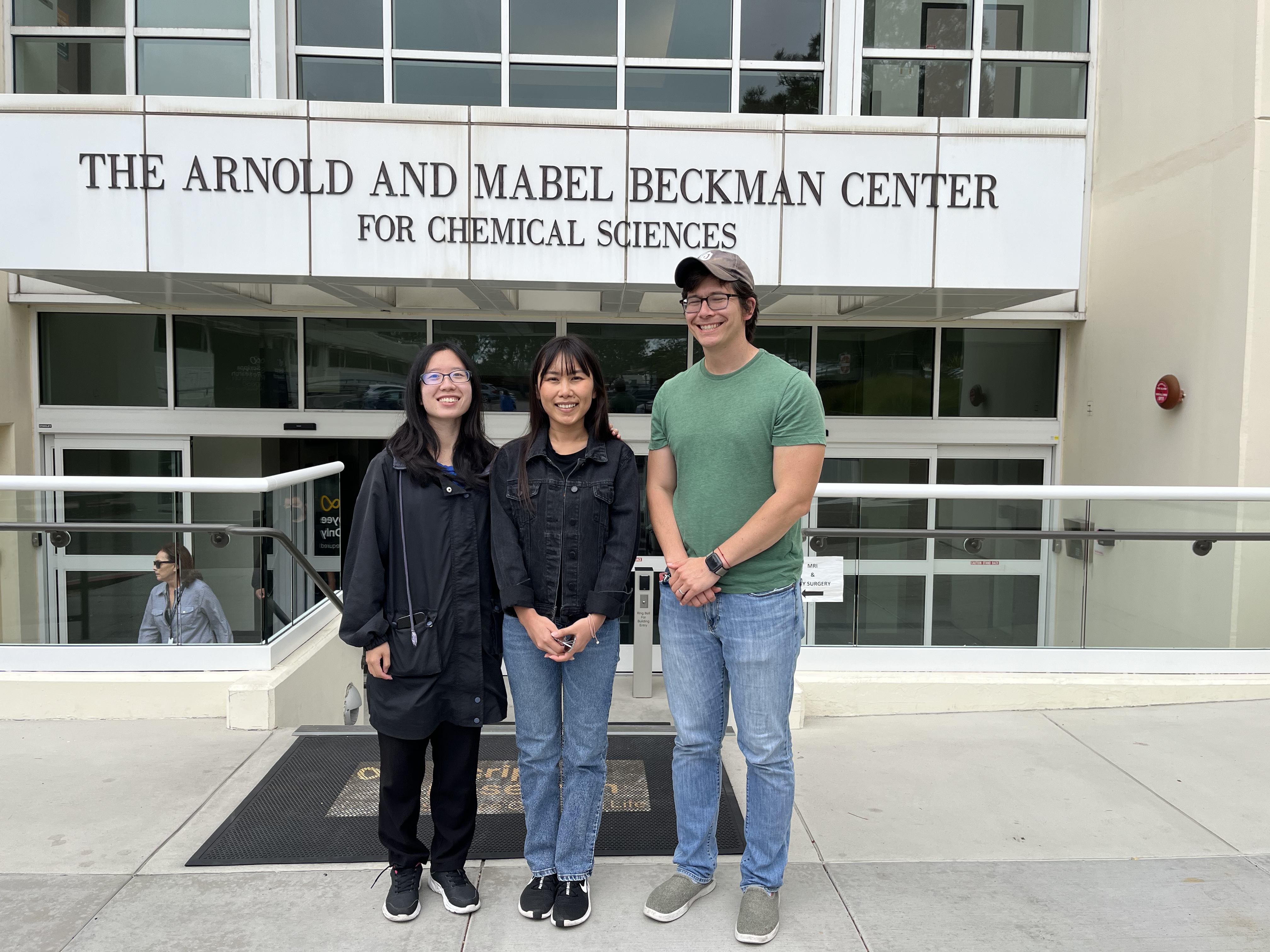
Wishing you the best Por!

Today we bid farewell to Warabhorn (Por) Rodphon, who has finished her full-year internship in our lab. We were very happy to be able to give Por a proper send off, including a ramen trip! Best of luck in your next adventure and we can’t wait to see all of your accomplishments! We miss you already! 

Alkyne 1,2-Oxyhalogenation In Press at Angewandte Chemie

The final version of our paper describing the directed 1,2-oxyhalogenation of unactivated alkynes appears online today in Angewandte Chemie International Edition. In this investigation, we demonstrate the successful extension of our labs approach for modular three-component π-bond functionalization from alkenes to alkynes. Specifically, we find that the 2-(pyridin-2-yl)isopropyl (PIP) amine directing auxiliary is able to mediated the classically challenging regioselective, three-component oxyhalogenation of internal alkynes, allowing for simple preparation of tetrasubstituted alkenes containing diversifiable functional handles. Congrats to Mingyu, Juntao, and Raul from Scripps, as well as our collaborators from the Lan group and Zhengzhou University and the Shi Lab at Zhejiang University.

For a link to the peer-reviewed paper in Angew. Chem. Int. Ed., click here: https://onlinelibrary.wiley.com/doi/10.1002/anie.202209099

For the initial pre-print that was deposited at the end of June, click here: https://chemrxiv.org/engage/chemrxiv/article-details/62a263752e62696e467d88b5

2022 Padres Home Game!

It has been a long time since we’ve been able to enjoy a group outing! This week, we did just that. We headed downtown to Petco stadium for an awesome Padres home game! It was great welcoming our new class of students and bringing back some old traditions!

GABBY AND ANUSH COMPLETE THEIR SUMMER INTERNSHIPS!

We bid Gabby and Anush farewell! After spending a chemistry-intense summer in the Engle lab, Gabby heads back to CSU San Marcos to complete her final year of coursework! Anush will be returning back home to finish his final year of high school! It was a great joy to hear about their summer accomplishments, in collaboration with Alena and Shenghua. Everyone from the Engle lab is wishing them the best luck in their future endeavors.

Welcome New Members!

To kick off the academic year, we welcome new members Madison Wagner, Yilin Cao, and Wenji He to the Engle lab!

We can’t wait to see all of the wonderful things they’ll do!

Directed alkyne oxyhalogenation pre-print online

Over the years, we’ve found that translating lessons learned in alkene difunctionalization to alkyne substrates is not as straightforwards as it seems, owing to unique reactivity profiles of alkyl- versus alkenylpalladium species. In our most recent collaboration with the Shi group from Zhejiang University and the Lan group from Zhengzhou University, we show that use of the 2-(pyridin-2-yl)isopropyl (PIP) amide directing group enables regio- and stereoselective oxyhalogenation of alkynes. The alkenyl halide products can be readily diversified via cross-coupling to access an array of tetrasubstituted alkene products. Congrats to Mingyu, Juntao, and Raul (Scripps Research); Tao (Zhengzhou U), Yi and Ye-Qiang (Zhejiang U) for an excellent study.

For a link to the ChemRxiv pre-print, click here: https://chemrxiv.org/engage/chemrxiv/article-details/62a263752e62696e467d88b5

Enantioselective three-component 1,2-diarylation and -arylalkenylation of alkenes – Pre-print now online

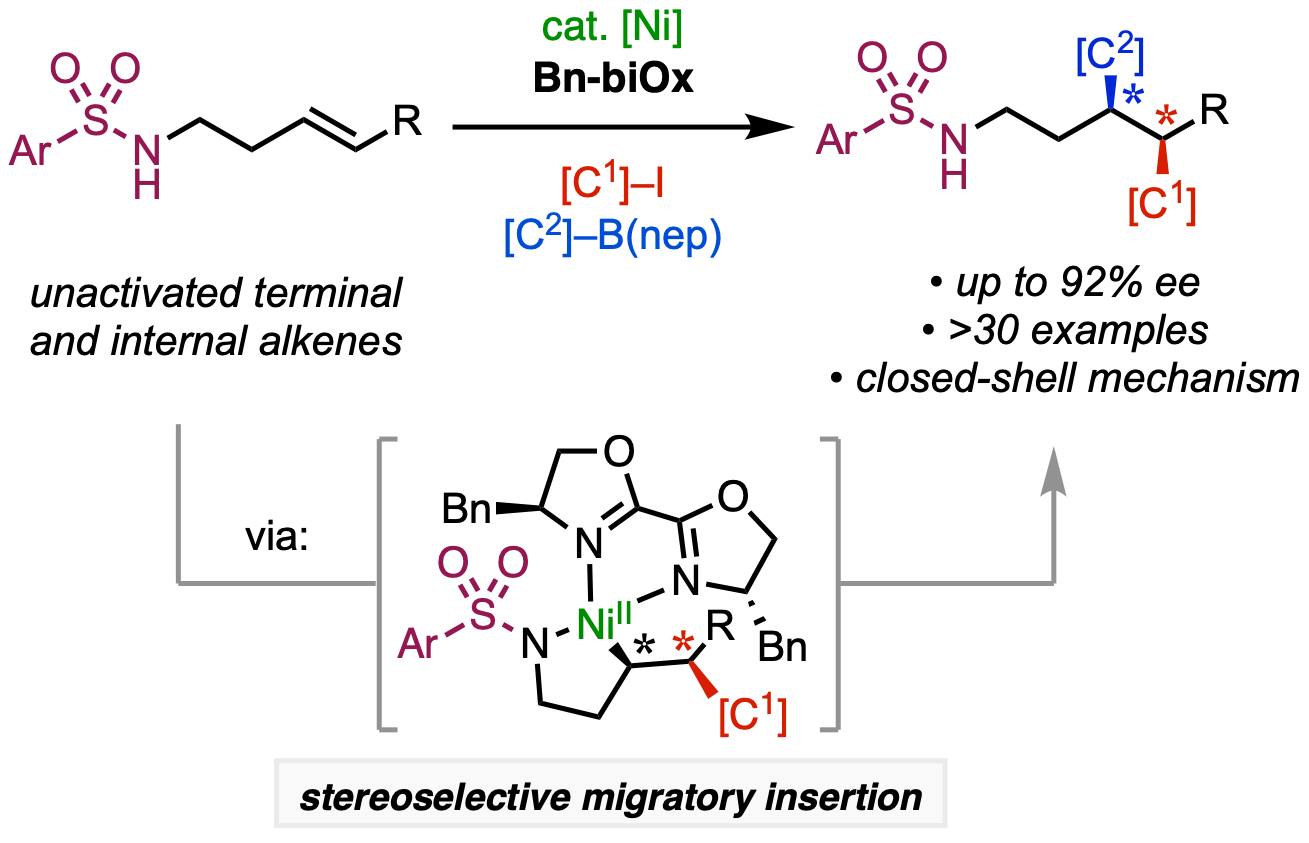
After >3 years of work, we are happy to share a ChemRxiv pre-print today describing a solution to a longstanding problem, stereoinduction in intermolecular arylnickel migratory insertion into alkenes, which we investigated in the context of interest in catalytic 1,2-dicarbofunctionalization. We found that a sterically bulky, achiral sulfonamide directing group works in synergy with a specially tuned hemilabile ligand (Bn-biOX) to promote high enantioselectivity with a variety of arylboron and aryl iodide coupling partners. Through use of experimental and computational techniques, we elucidated the mechanism of this three-component catalytic coupling, which involves an enantiodetermining migratory insertion step, which is distinct from previous radical-based methods. It was a great collaborative effort between our lab (Omar, Taeho, Pranali, Camille, and Joe), the Liu lab at the University of Pittsburgh (Turki), the Scripps Automated Synthesis Facility (Brittany, Quynh, Emily, and Jason), and Bristol Myers Squibb (Steve). Congrats to everyone!

For a link to the pre-print in ChemRxiv, click here: https://chemrxiv.org/engage/chemrxiv/article-details/62b40edc0bbbc1d407726e34