Hydroamination Review is Online

John’s new review article, “Regioselective Hydroamination Using a Directed Nucleopalladation/Protodepalladation Approach,” is online as of this morning at Synlett. The article covers the historical context for our group’s work in this area, published results from our laboratory, as well as outlook and perspective. Thanks to the Editorial Board at Synlett for the awesome opportunity to contribute this Synpact article, and congrats to John on a well-written piece! Click here for a link to the paper.

hydroamination review

Author Photo

Tanner Arrives and Begins Research in the Engle Lab

After a diverse set of research experiences at GlaxoSmithKline, Novartis, University of Tsukuba (J. Ichikawa), and the Okinawa Institute of Science and Technology (J. Khusnutdinova), Tanner Jankins begins graduate school at TSRI in the Engle lab. A graduate of Northeastern University, Tanner wasted no time jumping into the lab to begin preparing new ligand scaffolds, while still finding time to hit the beach for some surfing.

Pusu begins his research internship

Fresh off of the plane from Beijing, Pusu Yang arrives for a six-month research internship in the Engle Lab at Scripps. Pusu is a senior undergraduate at Nankai University, and at NKU he carries out research on rare-earth metal catalysts in the laboratory of Prof. Bingtao Guan. Having grown up in inner-Mongolia, Pusu is happy to swap the summer heat of Tianjin for the temperate climate of San Diego.

Ni-catalyzed conjuctive cross-coupling with unactivated alkenes

Today marks the Engle lab’s first foray into nickel catalysis. Congratulations to Joe, Van, and Mark for their paper in J. Am. Chem. Soc., which describes a new method to couple alkylzinc reagents, aryl iodides, and non-conjugated alkenes using a coordination control strategy. The work couldn’t have happened with our collaborator Jason Chen, the Director of the brand-new TSRI Automation Facility, who guided us through several challenging purifications and analyses. Special congratulations to Mark, who caps off his recent graduation from UCSD with the second paper of his undergraduate career. Click here for the link to the paper. Way to go, team!

Ni Cross-Coupling_TOC

IMG_2947(Not pictured: Mark)

Three-component alkene carboamination

In a manuscript appearing online today in J. Am. Chem. Soc., Zhen, Zichen (Forrest), and Tian (May) have teamed up with computational collaborators Yanyan Wang and Prof. Peng Liu at the University of Pittsburg to describe a new method to effect three-component carboamination of unactivated alkenes. The article describes reaction optimization, substrate scope, synthetic applications toward several drug compounds, reaction kinetics, and computational studies. This works marks the first collaboration with another research group from the Engle lab—hopefully the first of many! Special congratulations to undergraduate co-authors, Forrest and May. Forrest recently completed his undergraduate degree at Nankai University and will be joining the PhD program at the Shanghai Institute of Organic Chemistry. Click here for a link to the manuscript. Great work, team!

carboamination

pengIMG_2935
(not pictured: Zichen (Forrest))

Forrest jumps into summer research

Forrest Graham, a rising senior from Valhalla High School in El Cahon, CA, kicks off his summer research internship in the Engle Lab. Forrest is a participant in the Life Science Summer Institute, which gives talented San Diego area high school students the opportunity to perform research at TSRI and other nearby research institutes. When he’s not busy making new ligands to promote challenging catalytic reactions, Forrest can be found running up and down Torrey Pines Road, getting ready for cross country season.
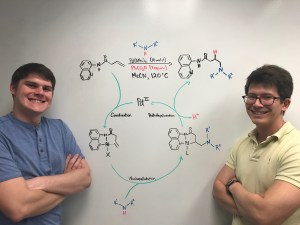
image1

Vincent Begins Summer Internship

After making it through his final quarter as a junior at UCSD, Vincent begins his summer internship in the Engle lab as part of the SURF program. Enthusiastic to explore transition metal catalysis, Vincent decided to begin his journey by synthesizing over 10 grams of starting material for screening new methodology.