Tridentate Directing Groups Now Available through Millipore-Sigma

MilliporeSigma has begun distributing the PPA and PAQ directing groups, which the Engle lab first described at the end of 2017. Thanks to MilliporeSigma for helping to make these useful auxiliaries more readily available to end-users across the world.
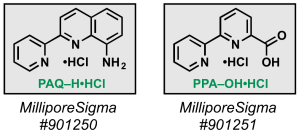
tridentate

PPA directing group for amine substrates:
https://www.sigmaaldrich.com/catalog/product/aldrich/901251?lang=en&region=US

PAQ directing group for carboxylic acid substrates:
https://www.sigmaaldrich.com/catalog/product/aldrich/901250?lang=en&region=US

Rei wins Honjo International Scholarship

Huge congrats to rising G3 student Rei Matsuura who has been selected for the 2018 Honjo International Scholarship, which will provide financial support for the remainder of her graduate studies in the Engle group. As per the organization’s website, the Honjo Scholarship Foundation provides scholarships to bright students who have the potential to become outstanding leaders to contribute to the peaceful development of the global community. Way to go, Rei!

61A874E8244C402ABFF799C2573DC77F

Zhen wins Bristol-Myers Squibb Graduate Fellowship

Congratulations to rising G4 student, Zhen Liu, who was selected for the prestigious 2018–2019 Bristol-Myers Squibb Graduate Fellowship in Synthetic Organic Chemistry. As part of the program. Zhen will present his research at the upcoming Bristol-Myers Squibb Chemistry Awards Symposium, which will be held in the spring of 2019 at the BMS research site in Lawrenceville, New Jersey. The entire Engle lab is extremely grateful to BMS for their support. Way to go, Zhen!

IMG_5022

New Summer Research Interns Arrive

Tian Zhang is joining us from Nankai University and will be working with De Wei (PD2). He is looking forward to learning some copper chemistry while taking the occasional break to go catch pokemon outside on pokemon GO.


Ziyang (Nick) will be joining us from USTC on a summer internship and will be working with Tanner (G1). Ziyang is excited to learn some glovebox techniques and try out surfing in San Diego.

Simple and Practical Reductive Heck Protocol for Terminal Alkenes

Today our lab reports a new method for hydroarylation of aliphatic and heteroatom-substituted terminal alkenes with (hetero)aryl iodides via a reductive a Heck coupling approach.  A description of the work is available as a pre-print on ChemRxiv (click here).  This reaction is trivial to set up, as it can be performed on the benchtop and uses exclusively reagents that are commercially available and commonly available in a standard organic chemistry lab. The transformation is notable for its compatibility with a myriad of functional groups, including those that are potentially reductively sensitive (epoxides, ketones, aldehydes, etc.) as well various aza-heterocycles commonly required in drug discovery. Key to the successful of this reaction is use of a high PPh3:Pd (10:1) ratio to suppress undesired beta-hydride elimination. Kudos to John who took on this significant challenge single-handedly and overcame numerous obstacles to bring this idea to fruition!

hydroarylation

Branched-Selective Oxidative Cyanation of Alkenes (Collaboration with Cravatt Lab)

Appearing online today in J. Am. Chem. Soc., the Engle lab and Cravatt group report the results of a joint investigation, encompassing the discovery of a new copper-catalyzed method to access branched alkenyl nitriles from simple alkenes and exciting applications of these compounds in organic synthesis and chemical proteomics. Congrats to all coauthors: De-Wei, Sri, Jose, and Yiyang (Elaine) from the Engle lab; and Katya and Radu from the Cravatt lab. Thanks to the Cravatt lab for a great collaboration (hopefully, the first of many). Click here for a link to the article.

cyanation

(not pictured: Sri and Yiyang (Elaine))


1,2-Aminohydroxylation reaction published in collaboration with BMS

Appearing online today is a new manuscript from a collaboration between the Engle lab and Bristol-Myers Squibb (BMS) describing the directed aminohydroxylation of non-conjugated alkenes using a weak oxidation system (2,6-dimethylbenzoquinone and O2 in HFIP). This method represents a convenient means of accessing beta-hydroxy-gamma-amino acids in an expedient manner from simple starting materials. To interrogate the reaction mechanism, we teamed up with process chemistry phenoms Drs. Mike Schmidt and Martin Eastgate from BMS, and together we established that the OH group of the product originates from O2 (potentially through the intermediacy of a peroxide or other reactive oxygen species). Congratulations to Tian (May) and Zhen from the Engle group as well as BMS coauthors Mike and Martin. Special props to undergraduate first author Tian (May), who managed to get the paper accepted only a few days before packing up and heading to her summer internship at Genentech, where she will spend a few months before starting her PhD at Caltech. May was the first undergraduate to publish a paper in the Engle group in 2016 and fittingly becomes the first undergraduate to complete a first-author contribution. Way to go team, and thanks to BMS for a great collaboration!