New Pre-Print Uncovers Molecules with Unique Isomerism

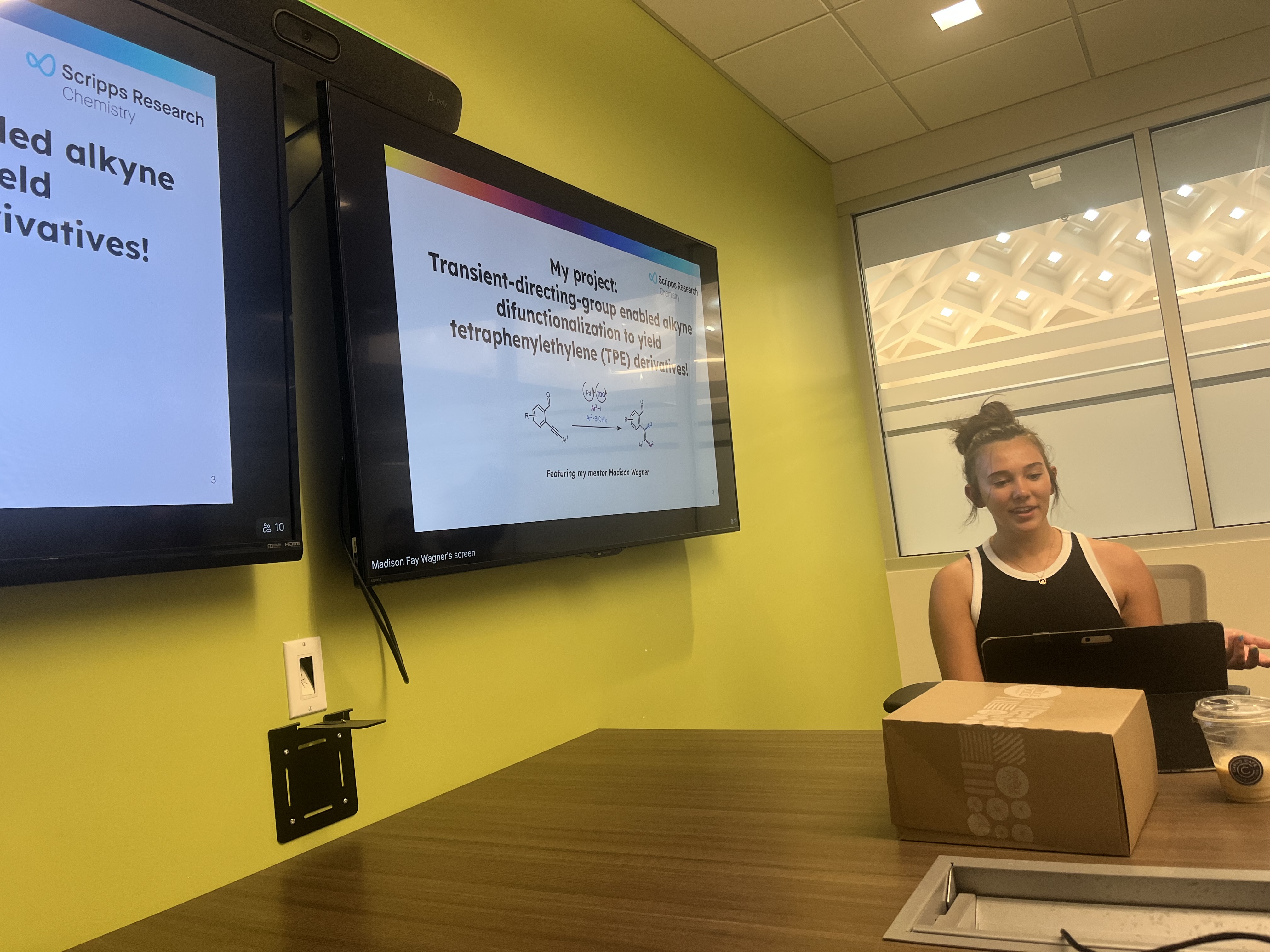
In our latest work, we describe a dual catalytic double Mizoroki–Heck arylation of ortho-(2-propenyl)benzaldehydes to furnish a special class of styrenyl products exhibiting equivalent atrop- and positional isomerism. The molecules are unique; inversion about the hindered C(aryl)–C(alkenyl) bond is equivalent to relocating the olefin to adjacent position (i.e., transposing a single H atom). Congrats to the entire collaborative team: Amit, Yiyao, Wen-Ji, and Madeline from Scripps Research; and Turki from the Liu lab at the University of Pittsburgh.

For a link to the pre-print in ChemRxiv, click here: https://chemrxiv.org/engage/chemrxiv/article-details/6835b62d1a8f9bdab53f41a4

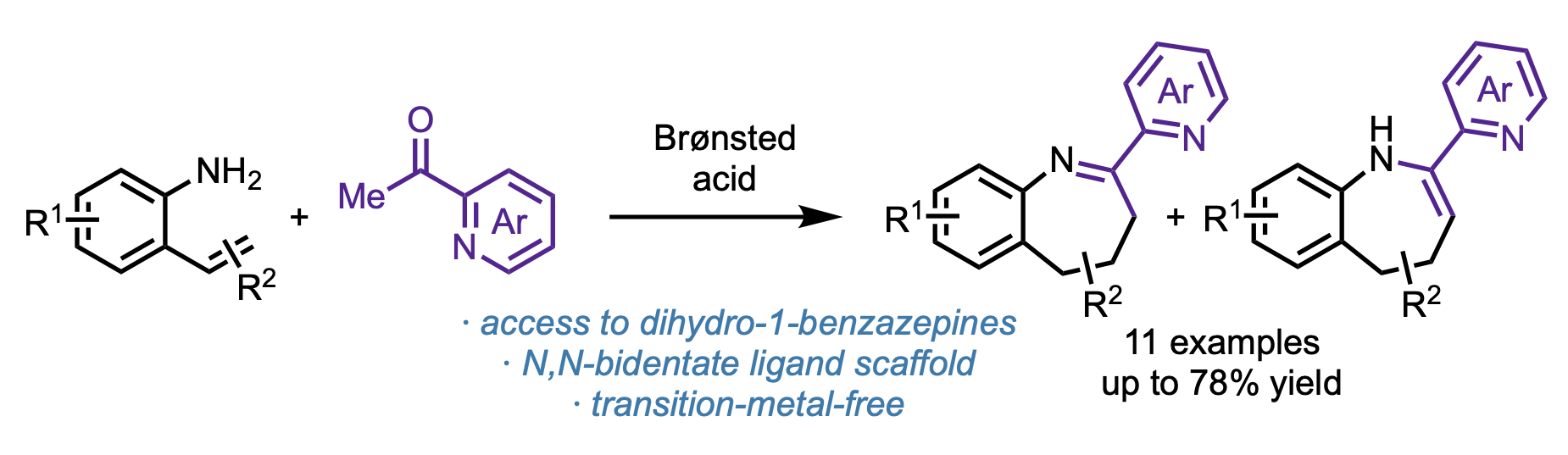
Simple Synthesis of Dihydro-1-benzazepines – Manuscript in Press in Tetrahedron Letters

A while back we observed formation of an unexpected byproduct in an attempted screen of various ketone-based transient directing groups (TDGs) for metal-catalyzed difunctionalization of ortho-alkenylaniline substrates. After initial condensation to form the corresponding ketimine, cyclization took place to furnish the corresponding dihydro-1-benzazepines. Recognizing the utility of the products, we optimized high-yielding reaction conditions, explored the scope and limitations of the method, and evaluated the potential of the products as ligands for transition metals. We are pleased to share the culmination of these efforts this week in Tetrahedron Letters as part of a special issue celebrating Prof. Song Lin’s Tetrahedron Young Investigator Award. Hats off to Alena and Jose for invaluable preliminary data and Letian and Juntao for getting the project to the finish line.

For a link to the paper in Tetrahedron Letters, click here: https://www.sciencedirect.com/science/article/pii/S0040403925001212

Phornphan joins the group as a visiting student

The Engle lab is pleased to welcome Phornphan Yongpanich, who is joining us for one year as a visiting Ph.D. student from Chulabhorn Graduate Institute (CGI) in Bangkok, Thailand. At CGI, Phornphan works in the lab of Prof. Jumreang Tummatorn developing enabling synthetic methods to access pharmaceutically relevant motifs. In the Engle lab, she will delve into the field of organometallic catalysis, while exploring all that San Diego has to offer. Welcome, Phornphan!

Alkylsulfonyl hydrazides push nickel-catalyzed C–H activation to new heights – pre-print now online

In an exciting new collaboration with the Baran lab, we find that the combination of alkylsulfonyl hydrazides and nickel catalysis unlocks unprecedented breadth in C(sp2)–C(sp3) cross-coupling via (hetero)aryl C–H activation. The method enables rapid synthesis of valuable attached ring motifs from minimally functionalized starting materials. Through a combination of experimental and computational techniques, we pinned down a unique C–H activation mechanism, termed amine-assisted asynchronous metalation/deprotonation, where the amine base used for radical generation plays a second role in mediating C–H cleavage. Congrats to the team led by Shuanghu and David from the Baran lab and Yilin from our group!

For a link to the pre-print in ChemRxiv, click here: https://chemrxiv.org/engage/chemrxiv/article-details/67e0130e6dde43c908ed25da

Newest Pre-Print Unlocks Copper as a Potent Catalyst for Alkyne Additions

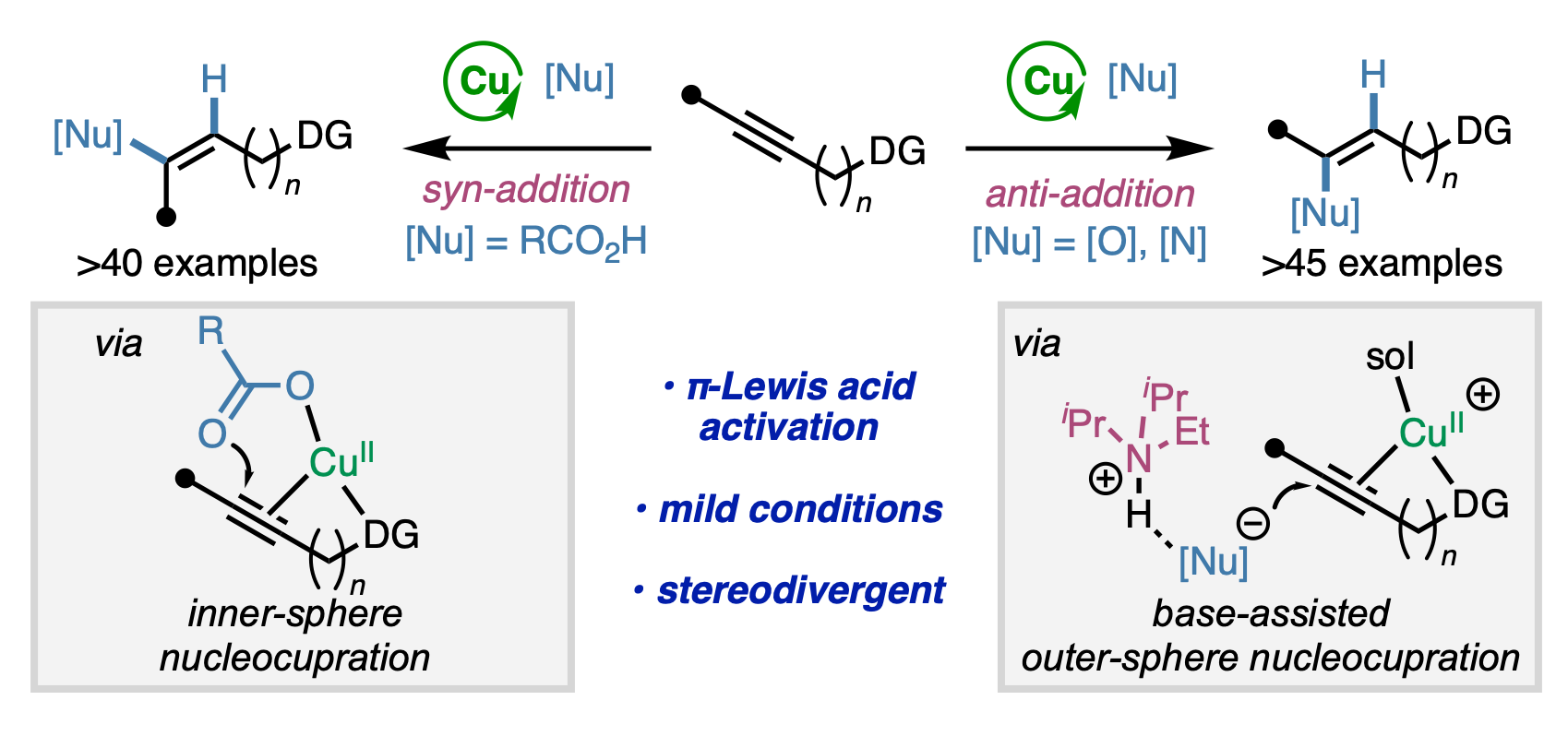
In the lab’s newest pre-print, we teamed up with the lab of Prof. Peng Liu at the University of Pittsburgh, to break ground on a new research direction aimed at unlocking copper as a general catalyst for nucleometalation to π-bonds. We discovered that under the right circumstances copper(II) is a potent π-Lewis acid that enables addition of various acidic OH and NH nucleophiles to unactivated alkynes, enabling stereodivergent access to enol esters, enolts, and enamides. Congrats to the project team: Juntao, Letian, and Shenghua from Scripps; and Thomas and Mithun from the University of Pittsburgh.

For a link to the pre-print on ChemRxiv, click here: https://chemrxiv.org/engage/chemrxiv/article-details/67a98e806dde43c9083f094e

Dr. Masahiro Masuda joins as the lab’s newest postdoc

This week we are excited to welcome the newest member of the team, Dr. Masahiro Masuda, who joins Scripps Research from Shionogi & Co, Ltd., where he currently works as a medicinal chemist. Dr. Masuda previously earned his Ph.D. in the Department of Applied Biological Chemistry at the University of Tokyo, working in the area of natural products total synthesis with Prof. Hirosato Takikawa. Welcome to the team, Dr. Masuda!

Letian completes his senior-year internship

We bid farewell to Letian Xu who completed his half-year undergrad internship with us this week and is now headed back to Nankai University to write his senior thesis. Letian was a stellar contributor to two different research projects, working under the mentorship of G4 student Juntao Sun. We will miss you and your passion for Bayern Munich, Letian! Can’t wait to see what you accomplish in graduate school and beyond.

C–N Atropisomers via C–H Activation – Now In Press

Appearing this week in ACS Catalysis, we report a method to access unique enantioenriched products containing a chiral C–N axis via C(Heteroaryl)–H activation. The reaction relies on the dual catalytic action of palladium(II) and an amino acid, the latter of which acts as chiral transient directing group (cTDG). Through a combination of density functional theory calculations, organometallic studies, and H/D exchange experiments, we showed that the role of the cTDG is to preferentially stabilize one of the two possible regioisomeric organopalladium species formed via C–H activation. Numerous classes of heterocycles are tolerated, and the synthetic utility of the products is demonstrated through various derivatizations, including a diastereoselective [4+2] cycloaddition. Congrats to Juntao, Yiyao, Wenji, Chen-Xi, Shenghua, and Quynh!

For a link to the paper in ACS Catalysis, click here: https://pubs.acs.org/doi/10.1021/acscatal.4c06788

As a reminder, an earlier version of this paper was published as a pre-print in ChemRxiv in November 2023: https://chemrxiv.org/engage/chemrxiv/article-details/6541721bc573f893f1889f75