Mingyu selected for 2020 Abbvie Symposium

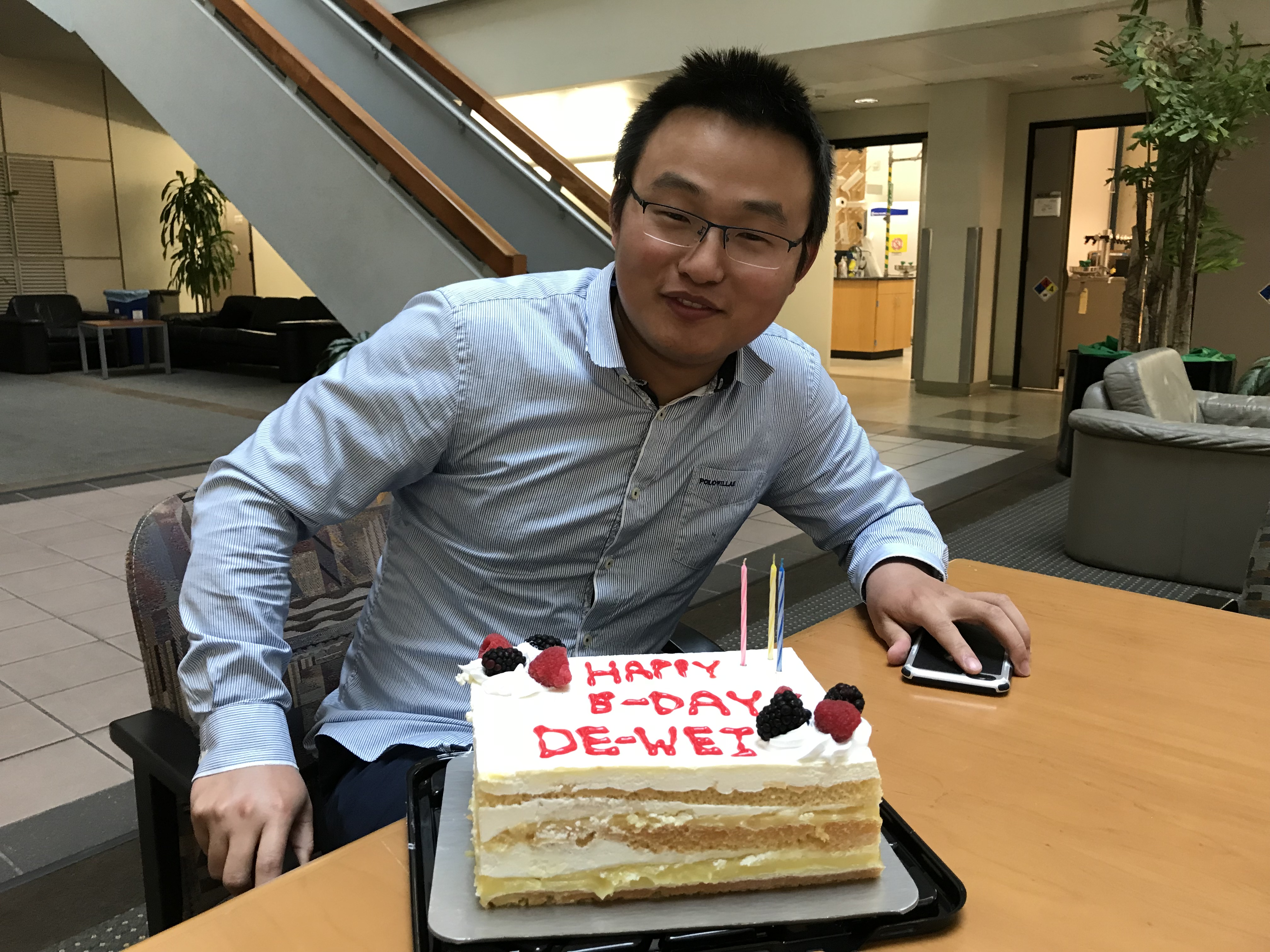
5ongratulations to rising G4 student Mingyu Liu who was chosen to represent Scripps Research and the Engle Lab at the 2020 AbbVie Scholars Symposium! The event takes place this week (Thursday, August 20) in virtual format, where Mingyu will have the opportunity to share his research with other students from around the country and with AbbVie scientists. Way to go, Mingyu!

Facile Solid-State Decomposition of Sodium Alkoxide Salts – Pre-Print Now Online

NaOMe, NaOEt, and related bases are widely used in organic synthesis and are readily available in solid form as free-flowing white (or off-white) solids. During research into cross-coupling reactions, our lab in collaboration with Bristol Myers Squibb discovered that these bases undergo rapid decomposition under air through a complex sequence of events. Today we disclose a pre-print in ChemRxiv describing our efforts to understand this phenomenon. It turns out that this process is so pervasive that even “new” commercial lots of these bases can contain almost none of the desired material. This was a long and circuitous detective story that challenged us to use every analytical trick in the book, from Karl Fischer titration to solid state 23Na NMR.

Read the full story here: https://chemrxiv.org/articles/preprint/An_Under-Appreciated_Source_of_Reproducibility_Issues_in_Cross-Coupling_Solid-State_Decomposition_of_Primary_Sodium_Alkoxides_in_Air/12818234

BCB Hydroboration Pre-Print Online

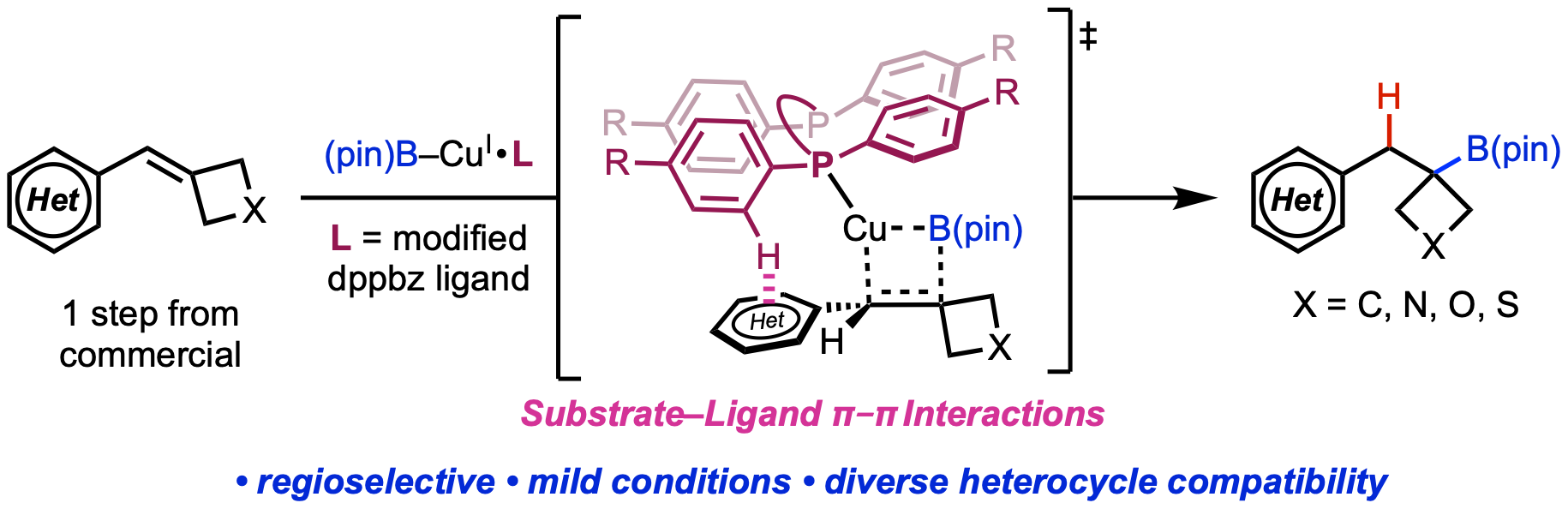
The latest story from our ongoing collaboration with the Liu group at the University of Pittsburg and Pfizer, Inc. appears online today in pre-print form on ChemRxiv. The new method effect hydroboration of benzylidenecyclopropanes, -azetidines, -oxetanes, and other related substrates. Key to the success of the reaction was the discovery of a specially modified dppbz ligand for the copper catalyst, which promotes the reaction through T-shaped π-stacking and other non-covalent interactions with the substrate. Congrats to G3 student Taeho and our high-school intern Kane from the Engle lab, Tuğçe from the Liu lab, and Gary, Alex, Sajiv, Ryan, Ru and Indra from Pfizer!

Please click here for a link to the pre-print: https://chemrxiv.org/articles/preprint/Multifaceted_Substrate_Ligand_Interactions_Promote_the_Copper-Catalyzed_Hydroboration_of_Benzylidenecyclobutanes_and_Related_Compounds/12788390

2nd-Year Students Pass Qual Exams with Flying Colors

Congratulations to our Engle lab’s G2 students (Class of 2023), Taeho Kang, Zi-Qi Li, Luke Oxtoby, and Alena Vasquez, for passing their qual exams and advancing to candidacy. Despite the COVID-19 pandemic, lab shutdown, and challenging working circumstances, these four maintained a great attitude and mastered the art of giving a great scientific talk over zoom. Looking forward to seeing what this class has in store for the next three years!

2020 OM Bootcamp kicks off this week!

The 2020 Organometallics Bootcamp kicks off this week (Mon, 8 am PT), and for the first time it will be held entirely over zoom. We are opening it up to any interested undergraduate students (especially those from PUIs!) who may have missed out on summer research opportunities. Please email keary(at)scripps.edu for more info if you are interested in learning more and potentially participating. Hope to see you there!

Keary wins 2020 Amgen Young Investigator Award

Keary has been named as one of the five recipients of the 2020 Amgen Young Investigator Award, as selected by Amgen’s Therapeutic Discovery and Drug Substance Technologies Departments. Congratulations to Keary and the other awardees!

• Keary Engle, Ph.D., Scripps Research Institute
• Jean-Philippe Julien, Ph.D., University of Toronto
• Alison Narayan, Ph.D., University of Michigan
• Sergey Pronin, Ph.D., University of California Irvine.
• David Veesler, Ph.D., University of Washington

The five speakers will receive funding to support research from Amgen and will participate in a virtual Young Investigator Award Symposium this fall.

Regiodivergent hydroarylation pre-print

Team Nickel continues to be hard at work during this challenging summer, and today we report the latest chapter in our work towards diverse regiodivergent alkene functionalization in collaboration with Liu group at the University of Pittsburgh. Specifically, we discovered that a systematically tuned Pyrox ligand is able to overcome the inherent tendency of alkenyl carboxylic acids to react in an anti-Markovnikov fashion in nickel(0)-catalyzed hydroarylation and -alkenylation with oranoboronic acids, instead favoring formation of the anti-Markovnikov product. Great work by all of the authors—Zi-Qi, Ruohan, Van, and Yang from our group, and Yue from the Liu lab.

For a link to the pre-print, click here: https://chemrxiv.org/articles/preprint/Ligand-Controlled_Regiodivergence_in_Nickel-Catalyzed_Hydroarylation_and_Hydroalkenylation_of_Alkenyl_Carboxylic_Acids/12650009

Pre-print from team nickel describing versatile sulfonamide-directed 1,2-diarylation

Not even a pandemic can slow down Team Nickel, who report a versatile method to effect 1,2-diarylation of diverse alkenyl amine derivatives, including those bearing challenging 1,1- and 1,2-disubstitution patterns. Key to the success of this work was the discovery of sulfonamides as uniquely effective groups for directing the nickel catalysts and then subsequently activating the nitrogen atom for diverse N-functionalization reactions.

For a link to the pre-print, click here: https://chemrxiv.org/articles/Sulfonamide_Directivity_Enables_Ni-Catalyzed_1_2-Diarylation_of_Diverse_Alkenyl_Amines/12642803

1,1-Diboration paper accepted in Org. Lett.

Yang and Zhong-Qian’s paper describing the copper-catalyzed conversion of the terminal alkynes to stereodefined 1,1-diborylalkenes has been accepted in Org. Lett. and appears in final form online today. Mechanistically, the reaction involves a tandem sequence of dehydrogenative C(sp)–H borylation with HBdan followed by hydroboration with HBpin with copper playing a dual role as catalyst for both steps. Preparatively, the method enables one-step access to valuable alkyl- and aryl-substituted 1,1-diborylalkenes, which can then be further diversified through sequential cross-coupling. Congrats to postdoc Yang and undergrad co-author Zhong-Qian!

For a link to the paper, click here: https://pubs.acs.org/doi/full/10.1021/acs.orglett.0c01901

This work was first described in April in a pre-print that was deposited on ChemRxiv: https://chemrxiv.org/articles/Synthesis_of_Stereodefined_1_1-Diborylalkenes_via_Copper-Catalyzed_Diboration_of_Terminal_Alkynes/12133404