
We have resumed our pumpkin carving tradition this year with potluck style festivities. Kudos to all of our artists performing phantastic in and out of the lab👏.

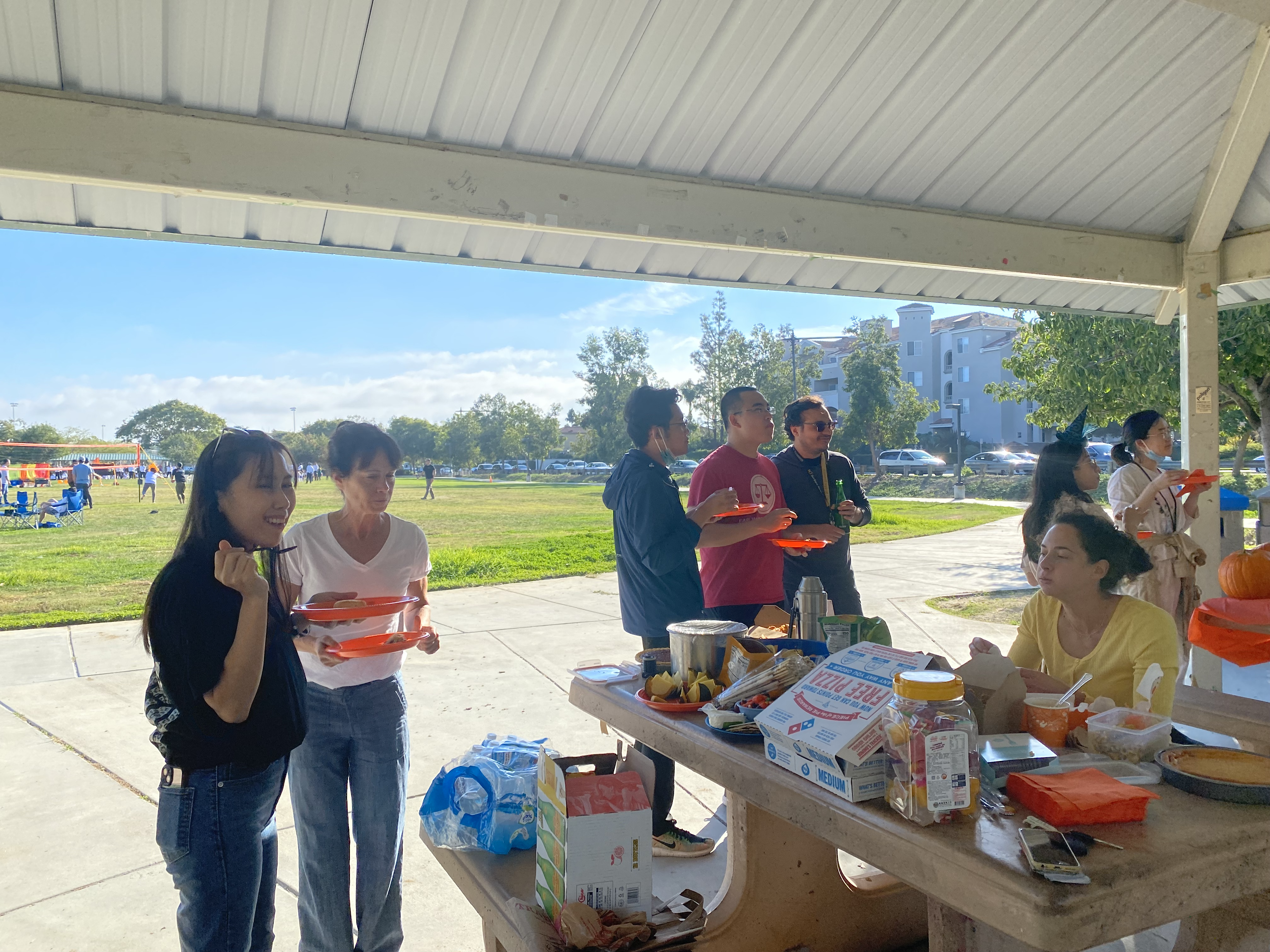

We have resumed our pumpkin carving tradition this year with potluck style festivities. Kudos to all of our artists performing phantastic in and out of the lab👏.
We are happy to share our most recent work with collaborators from Pfizer Oncology Medicinal Chemistry, appearing today as a pre-print in ChemRxiv, where we describe a versatile approach to carbo- and heterocycle synthesis from unactivated alkenes and ambiphilic organohalides. Under Pd(II)/Pd(IV) catalysis, the Wacker-type mechanism leads to net anti addition, which is distinct from classical Larock-type couplings. In this study, we systematically map structure–reactivity trends of the ambiphile, leading to unprecedented breath of reaction partners that can be employed. Congrats to everyone at Scripps (Hui-Qi, Phillippa, and Pranali), and Pfizer (Shouliang, Fen, Neal, Joyann, Michelle, and Indra) for a great team effort!
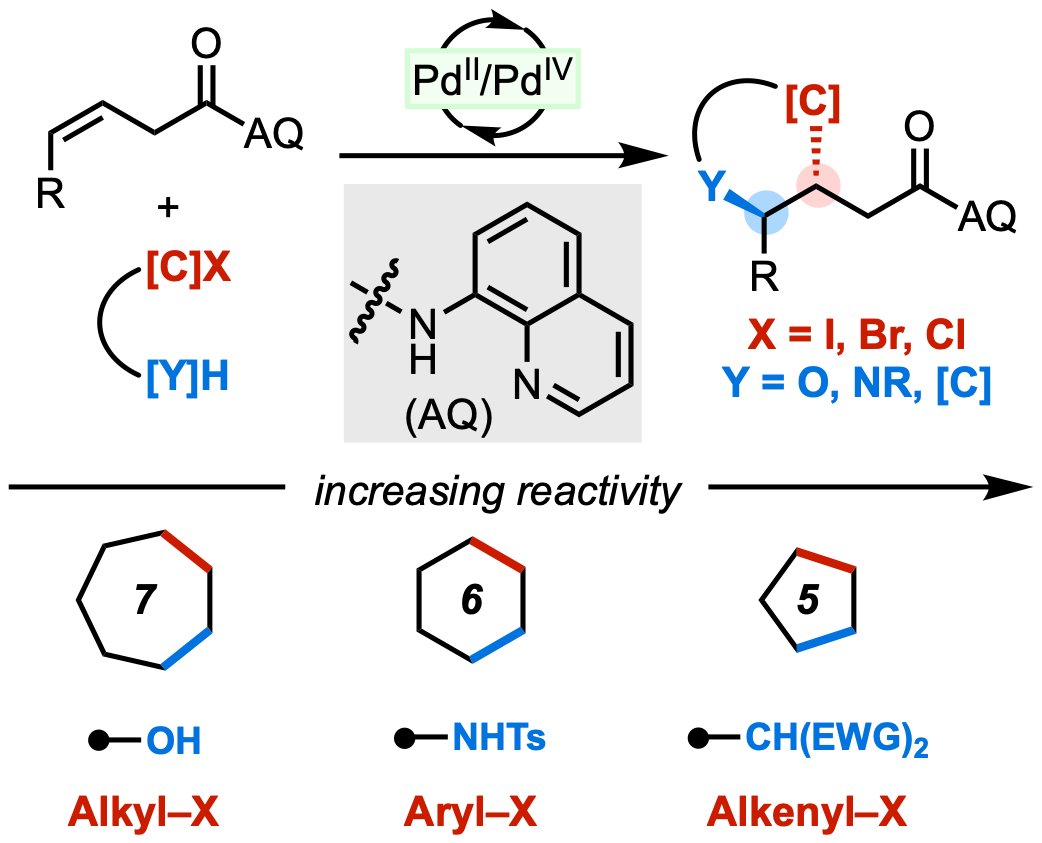
For a link to the pre-print, click here: https://chemrxiv.org/engage/chemrxiv/article-details/6172bcd10c0480fd773f44a4
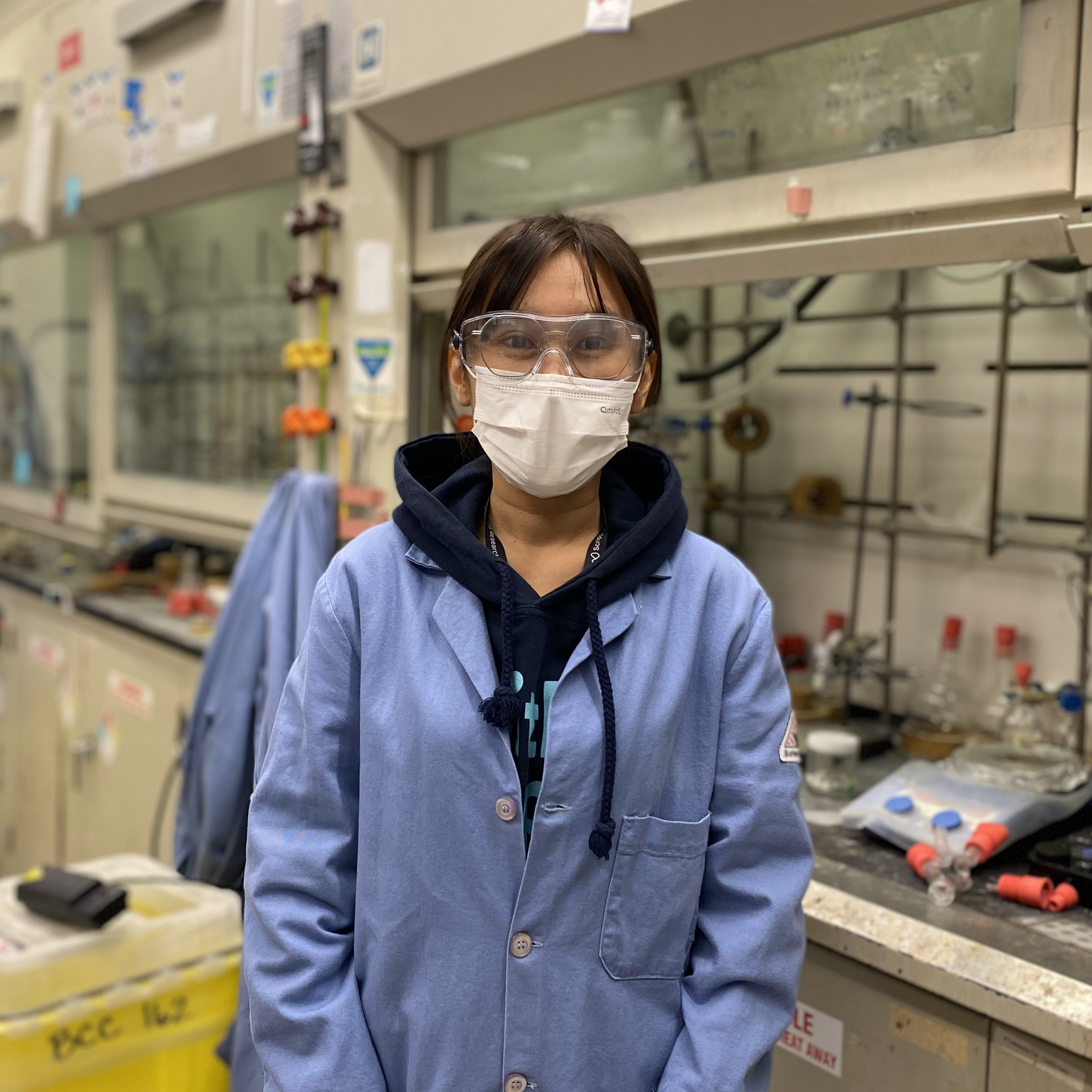

We have a new visiting student Waraborn (she goes by “Por”). Por flew all the way across the Pacific ocean from Thailand and ready to explore Pd catalysis with Amit. Welcome Por!
After a year of prolific research on tungsten and palladium catalysis, Phillippa has completed her postdoctoral research. She is returning to the UK to start at AstraZeneca in Macclesfield in the catalysis and high throughput experimentation team. Although we will miss her positive attitude, helpfulness, and excellent chemistry skills, we are excited to see what the future holds.
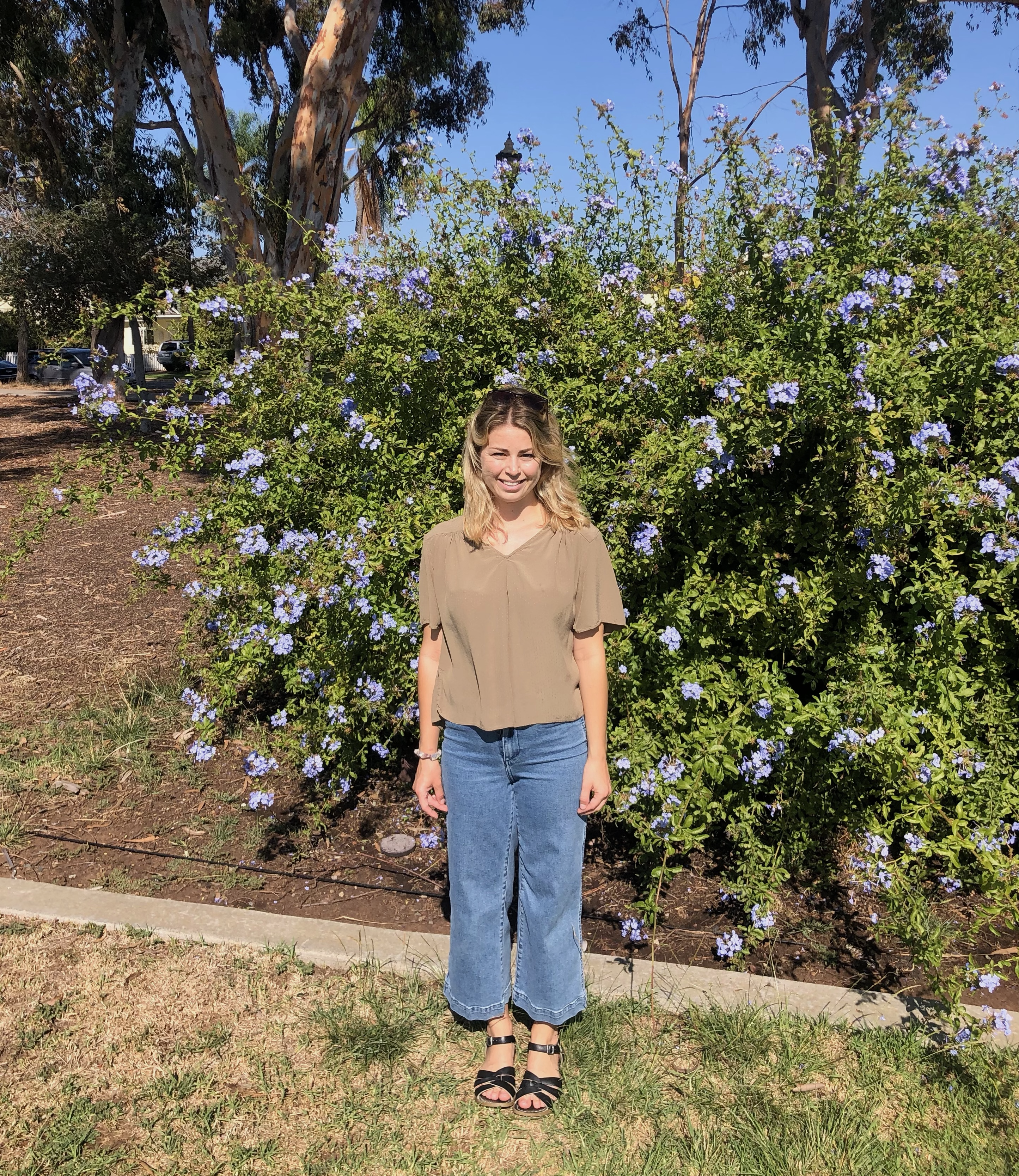
We have a new visiting undergraduate intern, Wenji He. Wenji comes from Nankai University, China, to explore Ni-catalysis in Engle group for a semester under mentorship of Ziqi.
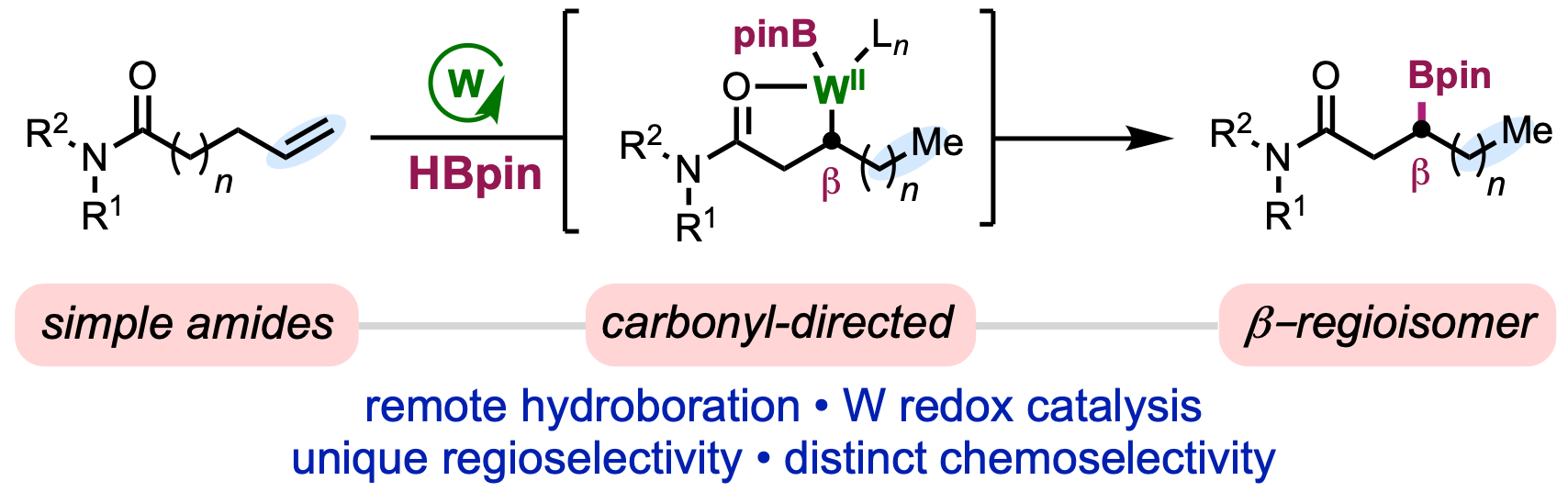
Appearing online today in J. Am. Chem. Soc., we are excited to share the final version of our paper on tungsten-catalyzed alkene isomerization–hydroboration, which we carried out in collaboration with the lab of Prof. Ruben Martin at ICIQ. This project represents an important step forward for our research program in low-valent tungsten-catalyzed alkene functionalization, a largely unexplored family of reactions. In this report, Tanner and Raul teamed up to demonstrate that simple amides are competent directing groups to mediate controlled isomerization and hydroboration of alkenes, allowing functionalization positions that are classical inaccessible via chain-walking methods. The method also represents the first tungsten-catalyzed hydroboration, and the mild nature of the process is exemplified by it’s tolerance for a number of sensitive functional groups (e.g., aryl halides) and epimerizable α-stereocenters. Congrats to Tanner, Raul, and Phillippa, and thanks to the Martin lab for the fun opportunity to join forces!
For a link to the paper in J. Am. Chem. Soc., click here: https://pubs.acs.org/doi/abs/10.1021/jacs.1c07162
As a reminder, a pre-print of the paper first appeared in ChemRxiv back in July: https://chemrxiv.org/engage/chemrxiv/article-details/60e77eb2551cb06ecbadb7a4
We bid Yillin and José farewell! After spending a chemistry-intense summer in Engle lab, Yillin heads back to Santa Babara, and José hops on a long flight back to Spain. It was a great joy to hear about their amazing accomplishments Ni-catalysis, in collaboration with Ziqi and Taeho, during their wrap-up talks. Everyone from the Engle lab is wishing them the best luck in their future endeavors.


Congratulations to rising G4 student Luke Oxtoby who was chosen to represent Scripps Research and the Engle Lab at the 2021 AbbVie Scholars Symposium! The event takes place this week (Thursday, August 26) in virtual format, where Luke will have the opportunity to share his research with other students from around the country and with AbbVie scientists. Way to go, Luke!
Congratulations to rising 4th year graduate student Zi-Qi Li, who has been selected for a prestigious 2021–2022 Bristol Myers Squibb Graduate Fellowship in recognition of her research on palladium- and nickel-catalyzed alkene functionalization. Zi-Qi will present her research along other graduate fellows at BMS in the spring. Way to go, Zi-Qi!

For the past 5+ years, simple alkenyl alcohol substates have been on our wish list of “ideal” substrates for directed three-component alkene difunctionalization. However, extensive efforts within our lab and by others have proven that these starting materials are especially challenging due to a number of competitive side reactions that can arise (cyclization, alcohol oxidation, alkylmetal chain-walking, etc.). In an exciting study appearing online today in J. Am. Chem. Soc., Taeho and Nana together with Bristol Myers Squibb collaborators Peter, Klement, and Hao, have demonstrated a creative approach to integrate alkenyl alcohols into three-component carboamination that hinges on judicious tuning of the leaving group on the nitrogen electrophile. By carefully modulating the LUMO energy of this reaction partner, high pathway selectivity for the desired three-component coupling can be achieved across a broad array of substrates. Congrats to the team on this awesome advance!

For a link to the published manuscript in J. Am. Chem. Soc., click here: https://pubs.acs.org/doi/10.1021/jacs.1c07112.
As a reminder, a pre-print of this paper was published back in March: https://chemrxiv.org/engage/chemrxiv/article-details/60c7562e567dfebe64ec63f7

