Undergraduate intern Madeline Fitzgerald is visiting the lab from Davidson College. Madeline previously worked in the group of Prof. Hanna Key on the application of enzyme catalysis in organic reactions. She joins the lab as a SURF fellow and will be working with Amit and Madison on palladium catalysis. Welcome to the group, Madeline!
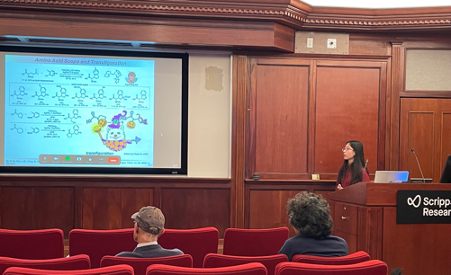
Today we report a unique approach to heterocycle synthesis, in which a C(sp3)–H bond and a C(sp3)–X (X = N, O, or S) undergo catalytic coupling with an ambiphilic aryl halide under Pd(II)/Pd(IV) catalysis. The reaction leverages a C(sp3)–H activation/β-X elimination strategy for strong bond cleavage previously developed by our lab. The method can be used to prepare difficult-to-access non-proteinogenic amino acids from methionine and transfigure unstrained heterocyclic starting materials. Congrats to the entire project team: graduate student Hui-Qi, visiting undergrad Jing-Chen, and the fantastic group of collaborators from Pfizer!
In the lab’s most recent review article, Taeho and Omar summarize the state of play in asymmetric Pd- and Ni-catalyzed dicarbofunctionalization. This emerging suite of reactions has undergone rapid development in the last decade, yet there are numerous lingering problems remaining to address to unlock the full potential of this transformation in organic synthesis. Thanks to the editorial team at Synthesis for the invitation to contribute, and congrats to Taeho and Omar.
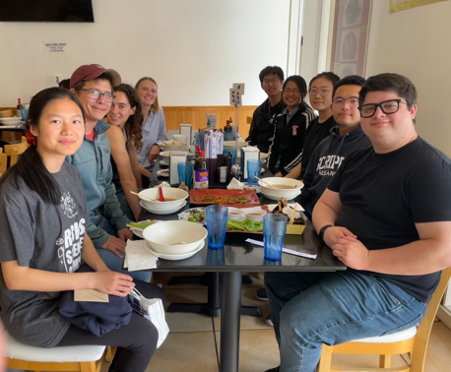
After 1.5 years of working in the Engle lab, we bid farewell to Anna! During her productive stay in the group, she worked on projects in collaboration with both Taeho and Wenji. We celebrated Anna’s achievements with a lab-wide lunch. Anna is graduating from Rancho Bernardo high school, and she will be starting her undergraduate studies at MIT in the fall. We wish Anna the best of luck in all her future endeavors!
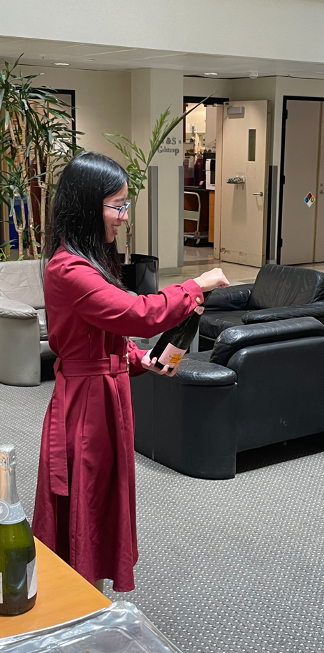
Congrats to the Engle lab’s newest doctor, Hui-Qi Ni!
Hui-Qi’s Ph.D. research focused on streamlining the synthesis of carbo- and heterocycles. She spearheaded the development of palladium-catalyzed alkene annulation reactions to obtain these motifs. Hui-Qi will soon start her postdoc in the lab of Prof. Nathanael Gray at Stanford.
The final version of our redox-paired alkene difunctionalization paper appears online today in J. Am. Chem. Soc. In this study, we outline a novel redox paradigm for alkene difunctionalization in which an oxidative difunctionalization process is coupled to a reductive difunctionalization process without any additional terminal oxidants or reductants. The unique mechanism of this reaction involves a PdII/PdIV/PdII/PdIV catalytic cycle, as elucidated through experiment and computations. Congrats to the entire project team, and thanks to our collaborators Prof. Ken Houk from UCLA and Prof. Peng Liu from the University of Pittsburgh.
The newest method to emerge from the group builds on our interest in developing catalytic strong activation reactions via β-X elimination. We have previously demonstrated that PdII(π-olefin) intermediates generated in this manner can be engaged in nucleopalladation / protodepalladation sequences to effect functional group metathesis of an outgoing C(sp3)–X (X = C, N, O, F, etc.) for a new C(sp3)–C or C(sp3)–N. In our newest pre-print, Hui-Qi, Jing-Chen, and collaborators from Pfizer extend the reach of this approach, demonstrating annulation of transiently generated PdII(π-olefin) intermediates via β-X elimination. In terms of synthetic planning, the reaction allows conversion of simply aliphatic alcohol, amine, and thiol compounds into valuable heterocyclic products. Especially exciting applications are in amino acid upgrading and heterocycle transfiguration. Congrats to the team!
We have a new undergraduate intern Xiaowei Chen visiting from Rice University. Xiaowei previously worked in the group of Prof. Julian West on ligand-to-metal charge transfer photocatalysis. She joins the lab as an AYRIU scholar and will be working with Anne to explore nickel catalysis. Welcome to the group, Xiaowei!
Appearing online today in Angewandte Chemie International Edition, we describe the most recent findings from our program in dual catalytic enantioselective alkene functionalization via a transient directing group strategy. Specifically, we developed a method for hydroalkenylation and hydroalkynylation of alkenyl aldehydes that is enabled by reversible condensation of tert-leucine. Together with the lab of Prof. Peng Liu at the University of Pittsburgh, we applied density functional theory to elucidate the structural features of the amino acid co-catalyst that lead to high catalytic efficiency and high enantioselectivity. Congrats to the entire project team!










 Molecular Complexity through Catalysis