Directing Group Flexibility Unlocks Hindered Alkene Substrates – Pre-Print Now Online

In our latest pre-print, we explore the origins of diminished reactivity of α,α-gem-disubstituted alkenyl amides through a combination of kinetics, organometallic synthesis, and density functional theory, allowing us to pinpoint the rigidity of our standard 8-aminoquinoline amide directing group as problematic in a key step in the catalytic cycle. Switching to a simple flexible directing group leads to >115x rate acceleration and dramatic expansion of substrate scope. The work was made possible through a multi-institutional team from Scripps Research (Engle and Blackmond labs), the University of Pittsburgh (Liu lab), Bristol Myers Squibb, Enamine! Congrats to the project co-leads, Al, Gift, and Shijia—as well as the entire team.
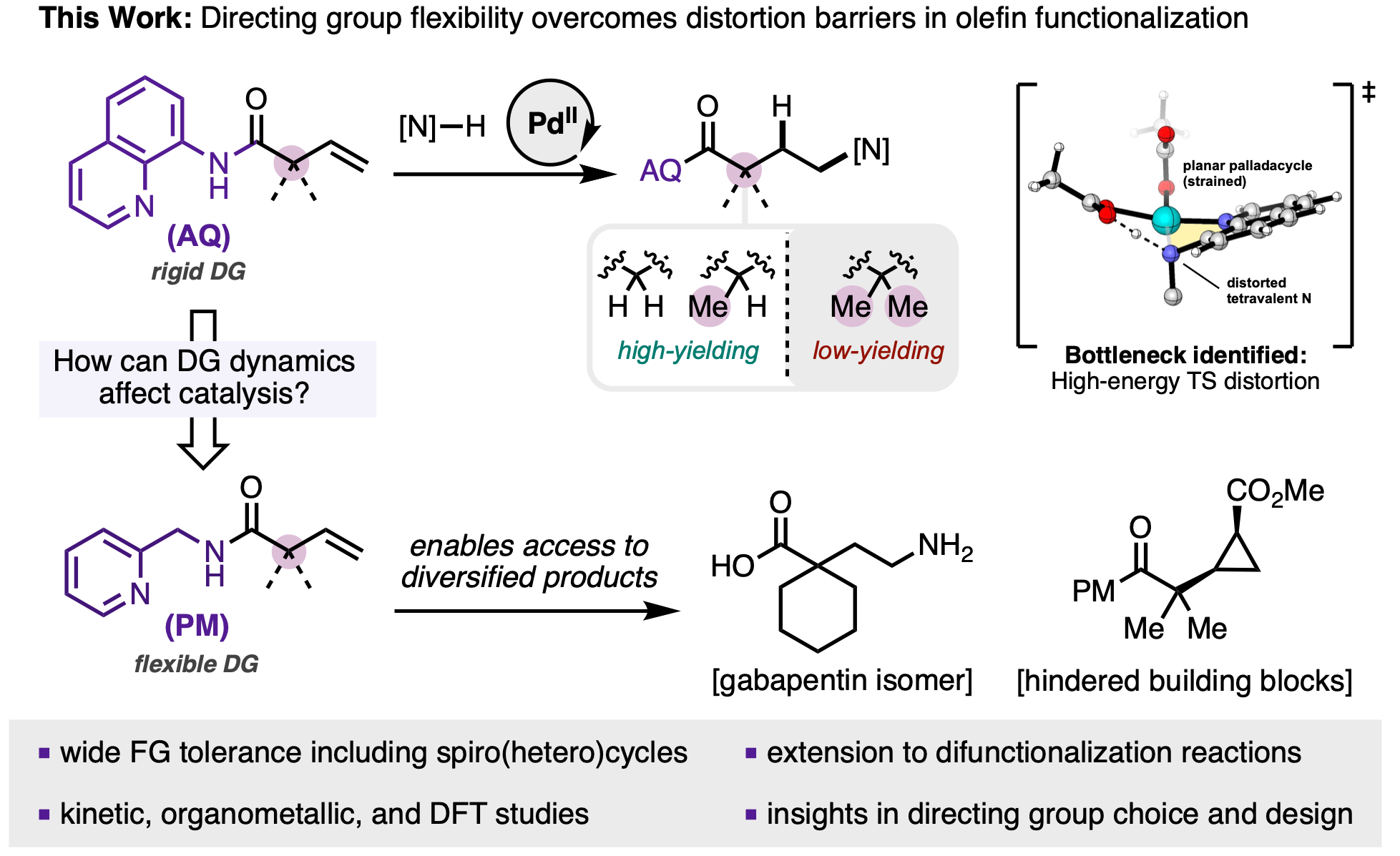
For a link to the pre-print in ChemRxiv, click here: https://chemrxiv.org/engage/chemrxiv/article-details/69368ccda10c9f5ca1daf3bf
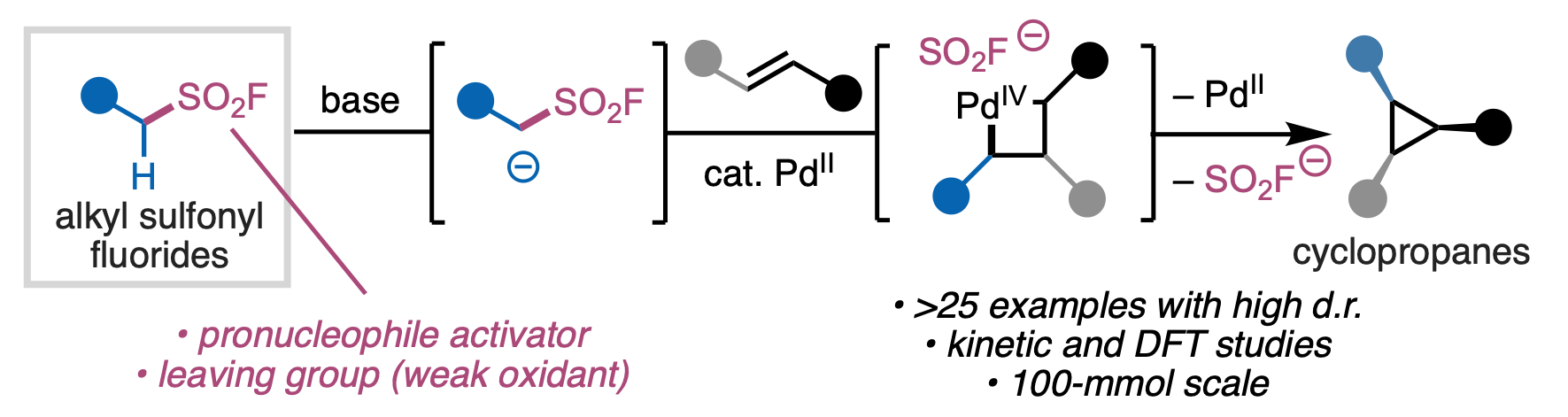
Catalytic Cyclopropanation of Olefins with Alkyl Sulfonyl Fluorides – Paper Now In Press

The final peer-reviewed version of our collaborative study on palladium(II)-catalyzed olefin cyclopropanation with alkyl–SO2F compounds appears this week in Nature Synthesis. Largely unexplored in catalysis, alkyl–SO2F compounds are an intriguing class of ambiphiles that can engage in nucleophilic reactivity upon deprotonation and electrophilic reactivity owing the the presence of the -SO2F leaving group. As we discovered in this study, these properties enable alkyl–SO2F to promote cyclopropanation through a unique mechanism that grants access to challenging substitution patterns and stereochemical outcomes. Congrats to the entire team of colleagues from Scripps Research, University of Pittsburgh, Enamine, and Pfizer!

For a link to the paper in Nature Synthesis, click here: https://www.nature.com/articles/s44160-025-00925-1.

As a reminder, we first deposited a pre-print on ChemRxiv back in November, 2024: https://chemrxiv.org/engage/chemrxiv/article-details/672b9b3cf9980725cf547804