Unique Chiral Styrene Derivatives Accessed via Dual Catalysis – Manuscript in Press in JACS

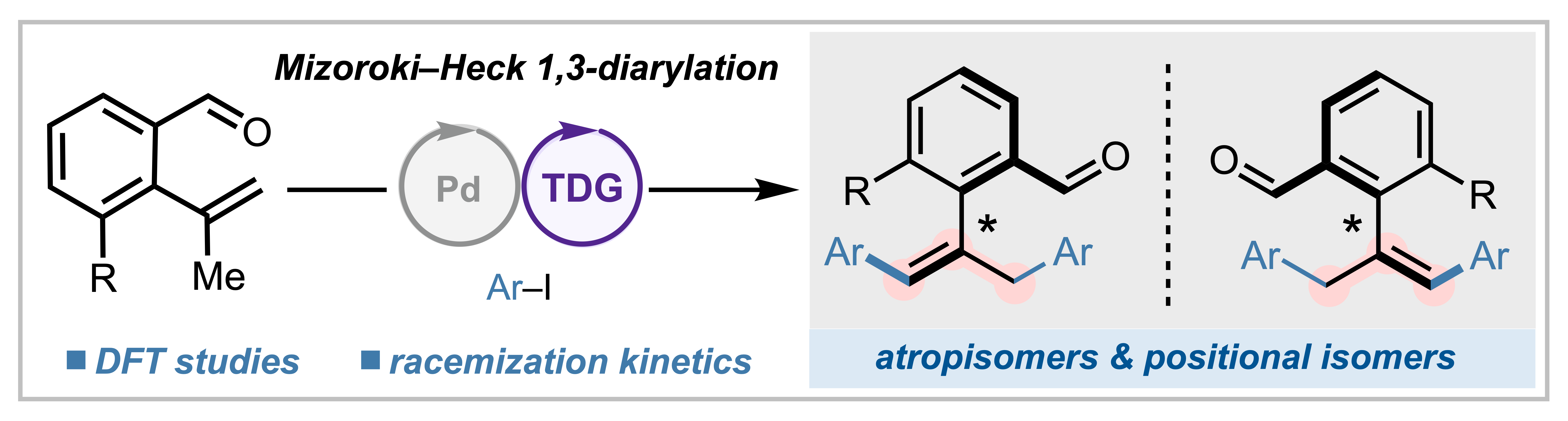
Appearing this week in J. Am. Chem. Soc., we describe a special class of substituted styrenes that exhibit equivalent atrop- and positional isomerism. In other words, inversion about the hindered C(aryl)–C(alkenyl) bond is equivalent to relocating the olefin to adjacent position. These unique molecules can be conveniently accessed via Mizoroki–Heck 1,3-homodiarylation under co-catalysis by palladium and an amino acid transient directing group (TDG), with density functional theory (DFT) calculations shedding light on how the amino acid controls multiple layers of selectivity in this cascade process. Congrats to the entire collaborative team: Amit, Yiyao, Wen-Ji, and Madeline from Scripps Research; and Turki from the Liu lab at the University of Pittsburgh!
For a link to the paper in J. Am. Chem. Soc., click here: https://pubs.acs.org/doi/full/10.1021/jacs.5c10118

As a reminder, we first deposited a pre-print in ChemRxiv back in May; click here for a link: https://chemrxiv.org/engage/chemrxiv/article-details/6835b62d1a8f9bdab53f41a4
Pumpkin Carving 2025

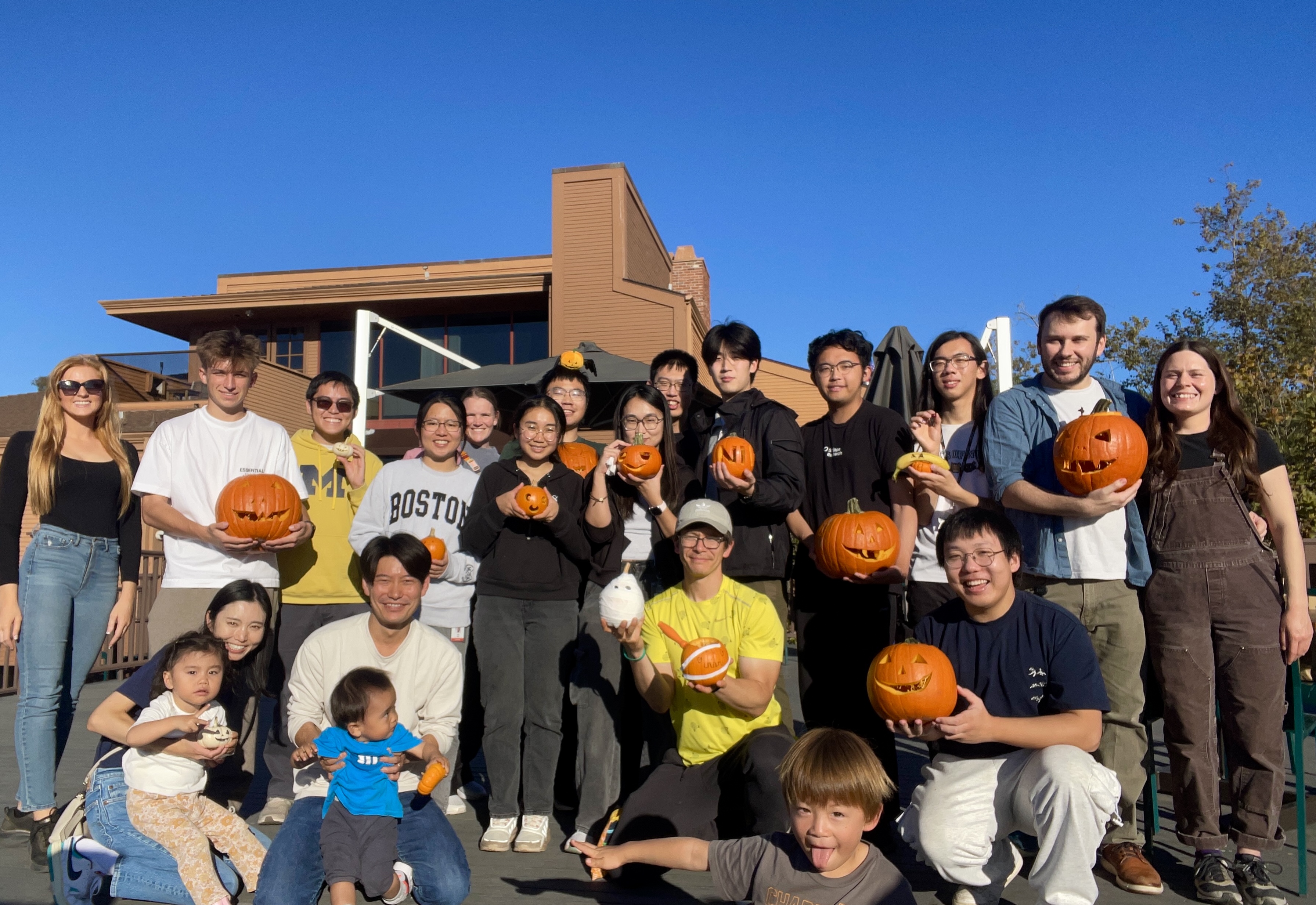
The Engle lab celebrated Halloween 2025 in style with our traditional pumpkin party, featuring spooky stylings, devilish deserts, and creepy carvings. One pumpkin and one child ended up mummified by the end of the evening! Happy Halloween!

New pre-print reveals new approach to unique polymers through three-component cross-coupling

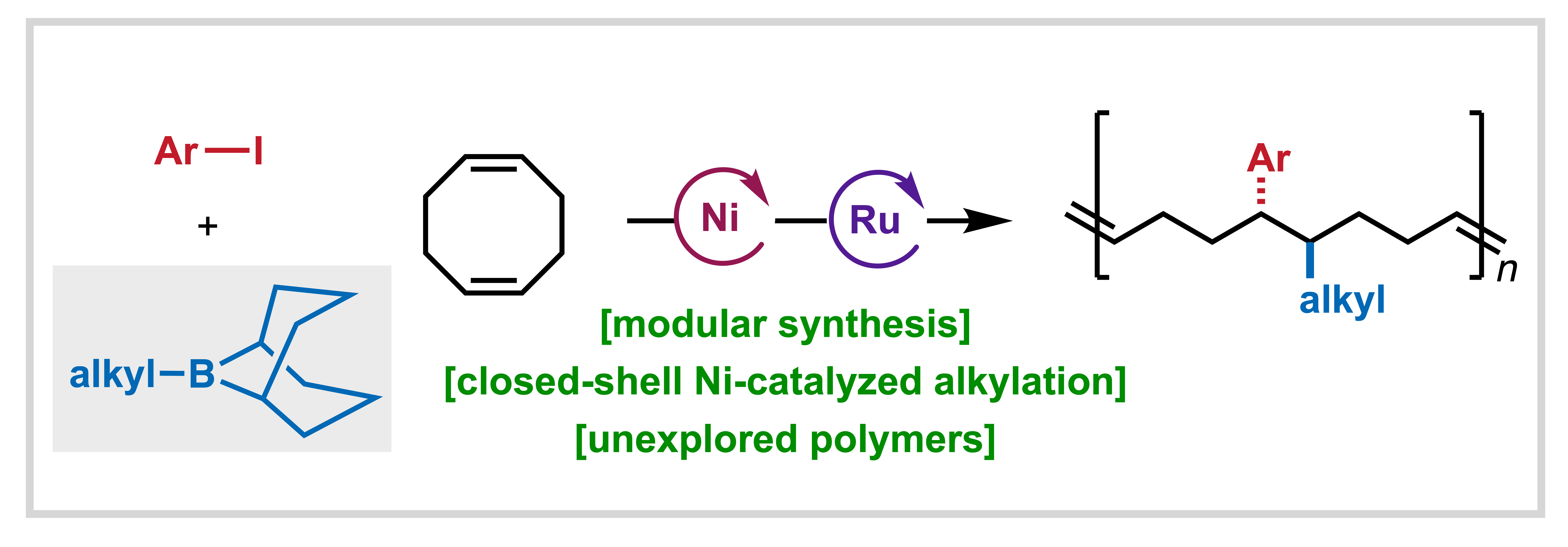
Our lab, together with collaborators at Bristol Myers Squibb, University of Pittsburgh, and Georgia Tech, has developed a new nickel-catalyzed 1,2-alkylarylation of 1,5-cyclooctadiene (COD) that enables access to previously inaccessible cyclooctene monomers bearing C(sp³) and C(sp²) substituents. This method employs alkyl-9-BBN reagents as effective transmetalating partners, maintaining a two-electron redox manifold and avoiding radical pathways incompatible with 1,5-cyclooctadiene. The resulting monomers undergo ring-opening metathesis polymerization (ROMP) to afford new polymers with tunable properties dictated by the alkyl and aryl coupling partners. DFT studies reveal that the enhanced reactivity of alkyl-9-BBN arises from destabilization of the pre-transmetalation complex, distinguishing it from less reactive alkylboronic esters. Congrats to the entire team: Anne, Aimee, and Camille from Scripps Research; Shijia from the Liu lab at the University of Pittsburgh; and Ethan from the Gutekunst lab at Georgia Tech; and Steve from BMS.

For a link to the pre-print in ChemRxiv, click here: https://chemrxiv.org/engage/chemrxiv/article-details/68e901addfd0d042d1dace4c

Chris joins the lab as a postdoctoral fellow

The Engle lab is pleased to welcome Dr. Chris Rybak, who joins Scripps Research after completing a stellar Ph.D. at Purdue University. As a member of Prof. Chris Uyeda’s lab at Purdue, Chris’s dissertation research focused on dinickel catalytic approaches to azoarenes. A lifelong midwesterner, Chris will soak in San Diego sunshine while exploring new areas of the d-block for catalytic method discovery. Welcome Dr. Rybak!